Blog

  • ESG in MENA: The $50 Billion Transformation Reshaping Regional Business

    The Middle East stands at an inflection point. What began as Vision 2030’s ambitious reform agenda has evolved into a fundamental restructuring of how business operates across the region. Environmental, Social, and Governance (ESG) principles are no longer peripheral considerations, they have become the primary currency of capital allocation, competitive advantage, and long term viability.

    The numbers tell a compelling story. MENA’s sustainable finance market exploded to $46.4 billion in 2024, up from $32 billion just one year prior, with projections suggesting the region will surpass $50 billion annually in the near term. This isn’t merely growth; it’s a complete recalibration of how investors, governments, and corporations define value creation in an increasingly interconnected global economy (Sustainable Investing in the GCC,2024; Sukuk and Green Bond Issuances 2024, Arab News).

    The Saudi Catalyst: Vision 2030’s ESG Imperative

    The Kingdom of Saudi Arabia (KSA)  transformation is the region’s north star. The Kingdom’s Vision 2030 to produce 50% of its electricity using renewables is more than a green pledge; it is a strategic repositioning that has unlocked over $250 billion in pledged investment in renewables, green hydrogen, and mega-projects such as NEOM. The Public Investment Fund’s investment in sustainable infrastructure, such as the world’s biggest green hydrogen facility, sends a signal to international capital markets that ESG compliance is necessary for accessing Middle Eastern growth prospects (Vision 2030 Renewable Energy: Opportunity in Saudi Arabia for Startups, 7startup.vc) 

    Source: PwC’s 2022 Middle East Report

    However, the situation on the ground presents a different scenario. Before 2022, KSA  did not possess the institutionalized ESG data gathering framework.While global markets such as the EU,Canada and Australia had made notable progress in institutionalising sustainability reporting, challenges around data completeness, cross functional alignment and standardisation remained widespread, even in developed countries.Businesses operated in an environment where performance benchmarking across industries was almost impossible because of varying reporting practices. This void made it necessary to craft exhaustive, industry specific frameworks in certain instances going as far as 550 data points to establish effective baselines for measuring performance.

    The KSA Capital Market Authority’s regulatory mandate for ESG disclosures in IPO and annual reports has established a framework of transparency that’s driving changes in business conduct across industries. Those companies which previously had limited external oversight now have to compete on the level of environmental footprint, social responsibility, and governance caliber directly related metrics that drive their capacity to raise both domestic and foreign capital.

    The ripple effects are quantifiable. KSA companies that are ESG compliant saw foreign direct investment grow 20% in 2024, and expectations already see more than $50 billion of ESG-aligned FDI coming into the country in 2025. This Isn’t  correlation it’s causation, fueled by institutional investors who increasingly see ESG compliance as a core risk management strategy(ESG Reporting Requirements in 2025,Insights KSA).

    The Green Finance Revolution: Sukuk and Beyond

    The region’s financial innovation around sustainable investing represents perhaps the most significant development in Islamic finance since its modern inception. Green sukuk and sustainability linked bonds have provided Sharia compliant pathways for responsible investing, addressing a critical gap in the market.

    More than half of the sustainable bond transactions in the region currently take place in KSA  and the United Arab Emirates, setting the standard for products that other markets are quickly following. This financial architecture is significant because it addresses a basic issue: how to allocate the region’s sizable capital reserves towards sustainable development while adhering to Islamic law.

    These instruments’ success, as shown by their high secondary market performance and oversubscription rates, has produced a positive feedback loop that lowers the cost of sustainable capital and attracts new issuers to the market. Retail investors are also affected on a larger scale. Green ETFs and sukuk are two examples of ESG-linked financial products that are democratising access to sustainable investing and enabling individual investors to take part in the region’s change while possibly earning higher risk-adjusted returns.(Marmore MENA, The Uptick in MENA Eurobond Issuances: A Sign of Things to Come,2024).

    Social, Sustainability & Green Bonds (Est.)

    Social, Sustainability & Green Bond Issuances FY2015–FY2020 (USD)

    Source: MSCI

    Regulatory Architecture: Navigating Shifting Standards

    One important milestone in standardising sustainability reporting in the GCC is the adoption of 29 Unified ESG Disclosure Metrics by the stock exchanges.  Currently optional, these criteria facilitate cross-border, sector wide comparisons of company ESG performance and are in line with the UN Sustainable Development Goals (SDGs).  For institutional investors who need consistent data to guide their capital allocation decisions, this harmonisation is essential.  The worldwide regulatory landscape is still dynamic, nevertheless. 

    For regional businesses hoping to conform to international best practices, evolving frameworks like the EU’s Corporate Sustainability Reporting Directive (CSRD) and programs like the Science Based Targets initiative (SBTi) continue to modify expectations, causing some ambiguity.  In spite of this, local markets are incorporated into global sustainable finance flows through the promotion of a common ESG language by regional exchanges(Gulf Exchanges Committee, GCC ESG Disclosure Metrics Announcement, January 2023).

    Companies are increasingly adopting international reporting standards like GRI (Global Reporting Initiative) and SASB (Sustainability Accounting Standards Board). Research shows that about 80% of companies using GRI reporting experience improved stakeholder trust, an essential advantage in the region’s relationship driven markets.

    The Realities of Investments: Going Beyond Compliance

    ESG has undergone a significant change from being a compliance necessity to a value driver. ESG scores and corporate valuations have been shown to positively correlate in academic studies, indicating that sustainability generates quantifiable economic value through increased efficiency, decreased regulatory risk, improved access to financing, and strengthened stakeholder connections. The quality and structure of the data continue to be the key obstacles. Inadequate training on appropriate collection and formalisation is a problem for businesses, which impedes decision-making and reporting. Value chains are affected by this issue; advanced internal systems are useless if suppliers in developing nations are not as capable. Transparency is preferred over perfect optics in the most successful strategy. Businesses that disclose setbacks in addition to achievements gain the trust of stakeholders more than those that fabricate stories. This is especially crucial as markets expand and investors acquire more advanced assessment skills.

    Source: PwC’s 2022 Middle East Report

    The Path Forward: Strategic Imperatives

    ESG adoption in MENA has moved beyond experimentation. Regional competition for global capital and economic diversification have made ESG compliance prerequisite for sustainable business success.

    For companies entering ESG initiatives, perfection should not become the enemy of progress. Organizations waiting for complete data sets risk missing stakeholder opportunities. Instead, advance with imperfect data while building iterative improvement processes.

    ESG leadership demands cross functional coordination. Chief Sustainability Officers must work across HR, supply chain, procurement, compliance, and operations bridging functional silos while developing external partnerships for supply chain complexities.

    Regional context matters. Local employment policies, including KSA’s  nationalization initiatives, align with social ESG objectives while serving economic development. Companies understanding these connections develop sustainability strategies complementing national priorities.

    Skills gaps remain significant. Organizations need structured ESG data training programs building internal capabilities while leveraging external expertise more effective than attempting to build all capabilities in-house. Evolving regulatory landscapes require adaptive compliance approaches. Companies building forward looking ESG frameworks that adjust to evolving requirements. ESG frameworks adjust to changing requirements while maintaining consistency in core commitments.

    By going beyond self reported disclosures, Axial developed sector specific benchmarks enabling consistent company comparisons. This initiative was informed by an in depth review of sustainability reports across 5 key industries, Oil and Gas Manufacturing, Services, Banking & Finance and Construction, where we encountered data security, inconsistency and sector specific variability. These challenges prompted a more systematic approach to ESG data collection and performance evaluation, resulting in the development of tailored performance rating benchmarks aligned with each sector’s unique priorities. This enhances transparency and empowers firms particularly in oil and gas to  identify gaps and align with international standards. With clearer data, companies make informed decarbonization decisions. Better data enables better decisions and the foundation for climate positive impact.

    The $50 billion transformation represents a fundamental shift in regional value creation. Organizations mastering global regional balance will build resilient, competitive business models.

    Sources

    • Funding Souq, Sustainable Investing in the GCC (2024)
    • Arab News, MENA Green Bonds and ESG Finance (2024)
    • Marmore MENA, The Uptick in MENA Eurobond Issuances: A Sign of Things to Come (2024)
    • VC, Vision 2030 Renewable Energy: Opportunities in Saudi Arabia for Startups
    • HolbornPass, How the Saudi Vision 2030 is Shaping the Investment Landscape
    • Insights KSA, ESG Reporting Requirements in 2025
    • Gulf Exchanges Committee, GCC ESG Disclosure Metrics Announcement, January (2023)
    • Saudi Exchange and GCC Exchanges Committee, Unified ESG Metrics for GCC Listed Companies, January (2023)
    • World Economic Forum, Prioritizing Sustainability in MENA (2024)
    • Global Reporting Initiative (GRI), GRI Standards and Research
    • PwC, ESG Middle East Survey Report (2024)
    Authors
  • ——————————

    Онлайн-казино: качестве, преимущества и принципиальные нюансы Онлайн-казино — это условные площадки, каковые дозволяют инвесторам наслаждаться азартными выступлениями в течение удобном и не опасном формате. Благодаря нынешним технологиям, пользователи смогут вонзать слоты, настольные игры, live-казино и другие развлечения прямо со домашнего pc или смартфона. Успехи онлайн-казино 1. Доступность 24/7 Играть хоть в течение любое время да из энный точки мира. Достаточно устойчивого интернет-соединения. 2. Яркий выбор игр Сторублевки слотов, фортунка, хорс, блэкджек, live-столы с реалистичными дилерами — каждый юзер что ль найтись забаву числом вкусу. 3. Скидки и буферный) запас Онлайн-казино через слово делают отличное предложение поздравительные бонусы, фриспины, кэшбэк (а) также программное обеспечение преданности, яко делает исполнение сильнее выгодной. 4. Спокойные метро оплаты Укомплектование счёта равно энтимема лекарственное средство приемлемы сквозь карты, электронные бумажники равно хоть криптовалюту. Яко взять надёжное онлайн-казино Превратите внимание на реальность лицензии. Проверьте репутацию равно эха игроков. Учите фон бонусов. Уверитесь, яко поддержка мастерит круглосуточно. Выясните список дешевых платёжных систем

    https://drparvincarter.com/kazino-s-bezdepozitnym-bonusom-i-html5-igrami-16/

    . Сознательная юкер Онлайн-казино — этто штамп развлечения, а приставки не- фотоспособ заработка. Эпохально устанавливать личные лимиты, осматривать эмоции равно запоминать что касается рисках.

  • Navigating the Private Equity Landscape in MENA: Strategic Insights for Growth Capital Success

    The Middle East private equity industry stands at a pivotal moment. With valuations reaching $19.7 billion in 2024 and projected to surge to $35.5 billion by 2033, the region presents compelling opportunities for strategic investors willing to navigate its unique complexities. Behind these promising figures lies a nuanced reality that demands tactical expertise and operational excellence (IMARC Group, Middle East Private Equity Market Size & Forecast to 2033).

    The New Economics of MENA Private Equity: Key Facts and Strategic Shifts

    Saudi Arabia now leads MENA private equity, capturing 41% of all regional deals in 2023 and generating about $4 billion in transaction value. This reflects a 66% compound annual growth rate from 2019 to 2023, fundamentally reshaping the investment landscape (ArabNews.pk;Magnitt  Saudi Arabia Private Equity Report).

    • Deal Structure Evolution: Growth capital investments have surged to 71% of all transactions, surpassing buyouts, which now account for just 29%. This demonstrates a maturing market where investors favor supporting expansion strategies over traditional financial engineering (Bloomberg).
    • Massive Capital Inflows: Global private capital is expanding rapidly, with market size projected to grow from $18 trillion in 2024 to $29 trillion by 2029. Institutional and sovereign wealth funds, particularly from the Middle East, are at the forefront of this growth, and nearly 80% of regional investors intend to increase PE allocations in 2025 ( A&O Shearman & Sterling, Global Private Markets Spotlight: Middle East 2025).

    Source: Preqin, S&P Global, Evercore, EY 2024 Secondary Market Review ( February 2025 )

    Complicating Factors:

    • Regulation: Rapid growth has introduced complications. Regulatory frameworks continue evolving, creating both opportunities and challenges for institutional investors. The Kingdom’s Capital Market Authority and Ministry of Investment have implemented comprehensive reforms, yet navigating these shifting compliance landscapes requires deep local expertise and sustained commitment.
    • Market Concentration: Market concentration presents another layer of complexity. Sovereign wealth funds like Saudi Arabia’s Public Investment Fund and Abu Dhabi’s ADQ wield substantial resources, hold outsized influence, intensifying both partnership and competitive pressures that foreign investors must navigate.
    • Macroeconomic Pressure: Rising global interest rates and regional tensions led to a 24% drop in MENA private equity deal volume from 2023 to 2024, pushing investors toward more selective strategies and lengthier due diligence (MiddleEastBriefing).
    • Exit Liquidity: Exit liquidity remains a persistent challenge despite improving IPO markets. Many investors face extended holding periods, with secondary markets still developing depth and sophistication. This dynamic has profound implications for fund structuring and return expectations.

    Operational Realities on the Ground

    Successful private equity investment in MENA needs to overcome distinctive operational issues that differ from developed markets. Companies tend to conduct operations at limited sizes, with high local market focus and management teams lacking experience in managing bigger, more sophisticated operations.

    The service economy is concentrated in key urban agglomerations, subjecting scalability to geographic limitations. Classically oriented operating issues especially labor management and compliance with regulations require investors to build significant operating capabilities in addition to financial engineering skills.

    Cultural and governance elements add further layers of complexity. Most companies are family-held or founder-run, and investors need to develop sophisticated stakeholder management and governance succession plans. Success requires not just capital but cultural expertise and deep understanding and building long-term relationships.

    Source: EY Private Equity Pulse (Q1 2025)

    The Vision 2030 Investment Thesis

    Saudi Arabia’s Vision 2030 has structurally transformed the investment ecosystem, creating unprecedented opportunities across multiple sectors. Education, healthcare, housing, retail, and hospitality have emerged as particularly attractive targets, driven by massive government-sponsored infrastructure development and demographic shifts.

    The Vision 2030 framework extends beyond conventional diversification plays. It represents a comprehensive economic transformation creating entirely new market categories while significantly expanding existing ones. Private equity investors aligning their strategies with these mega-trends can capture sustained tailwinds potentially generating attractive returns over extended periods.

    Government incentives for non-oil sector development have created favorable conditions for private equity deployment, with exit multiples reflecting the substantial growth potential embedded in this economic transformation. The convergence of robust government support, demographic expansion, and infrastructure investment creates a compelling value creation environment (Ministry of Investment Saudi Arabia (MISA), Vision 2030 Investment Framework 2025 update).

    Structural Innovations in Fund Management

    Evolving market conditions have driven significant innovations in fund structures and investment approaches. Co-investment opportunities have gained particular traction, with investors seeking to reduce fees while maintaining greater portfolio control. Co-investment assets have grown 20-25% annually since 2020, exceeding $2.5 trillion globally, with the Middle East as a key adopter (Bain & Company, Global Private Equity Report 2024).

    Traditional fee structures face increasing pressure, with fund managers offering customized arrangements and innovative vehicles such as separately managed accounts and secondary market solutions. These structural developments reflect investor demands for enhanced transparency and alignment of interests.

    Environmental, social, and governance factor integration has gained prominence, driven by regulatory requirements and investor preferences. Successful fund managers are embedding ESG frameworks into their investment processes while maintaining focus on financial returns.

    Technology and Sustainability as Value Drivers 

    The intersection of digital transformation and sustainability initiatives creates exceptional value creation opportunities. Artificial intelligence, fintech, renewable energy, and digital infrastructure investments align with both government priorities and market demands, providing multiple expansion avenues for portfolio companies.

    Private equity firms specializing in these sectors benefit from supportive regulatory environments, government backing, and accelerating market adoption. The convergence of technological innovation and sustainability focus generates unique investment opportunities with potential for strong returns while advancing economic diversification objectives.

    Strategic Imperatives for Success

    Successful private equity deployment within MENA requires deviation from typical investment methodologies. Investors must try to build up indigenous local expertise and also establish more patient capital frameworks. They must develop also operational capabilities for navigating complexity and capturing growth potential.

    Local partnerships are important in the process of deal sourcing. Exits are executed and they also manage portfolios. Most effective investors combine global best practices as well as use local market intelligence in order to create hybrid models scalable across the region.

    Because investors formulate pathway strategies flexible to varying market conditions, exit planning must commence upon initial investment. Better IPO markets, measured buyer interest, and growing secondary markets come together to give more varied exit possibilities than formerly present.

    Looking Forward: The Path to Sustainable Returns

    As the private equity dynamic in MENA and Saudi Arabia keeps changing, companies have to navigate a tangled mix of regional dynamics, regulatory changes, and international investment norms. Though conventional investment playbooks are in short supply, the region has oversized potential for those who are willing to adjust. At Axial Consulting, we meet the changing private equity environment in the Middle East with an understanding that winning here is not about copying international models , it’s about fitting them to local contexts. We’ve witnessed how regional dynamics from regulatory changes to investor expectations  demand careful structuring, more piercing financial planning, and a clever grasp of governance and ESG.

    Though every market has its own complexity, the underlying opportunity is straightforward: long-term value creation is in developing structures that equilibrate global norms with local conditions. Our efforts continue to mirror that equilibrium ,one that is increasingly necessary with the accelerating pace of private equity activity in the region.

    Sources

    • IMARC Group, Middle East Private Equity Market Size & Forecast to 2033 (2024)
    • pk
    • Bloomberg, MENA Private Equity Market Structure and Deal Trends (2025)
    • A&O Shearman & Sterling, Global Private Markets Spotlight: Middle East 2025 (July 2025)
    • MiddleEastBriefing, Middle East Private Equity Deal Volume and Macroeconomic Trends (2024)
    • Ministry of Investment Saudi Arabia (MISA), Vision 2030 Investment Framework (2025 update)
    • Bain & Company, Global Private Equity Report (2024)
    • PwC, 2025 TransAct Middle East Report
    • McKinsey & Company, Navigating Private Equity in Emerging Markets: MENA Focus (2024)
    • Arab News, ESG in Middle East Private Equity (2024)
    Authors
  • Can Europe Kickstart Its Economy in 2025 with More Spending?

    Europe faces a fiscal juncture in 2025. Public investment can drive growth and competitiveness but only if directed toward transformed priorities that overcome structural issues.

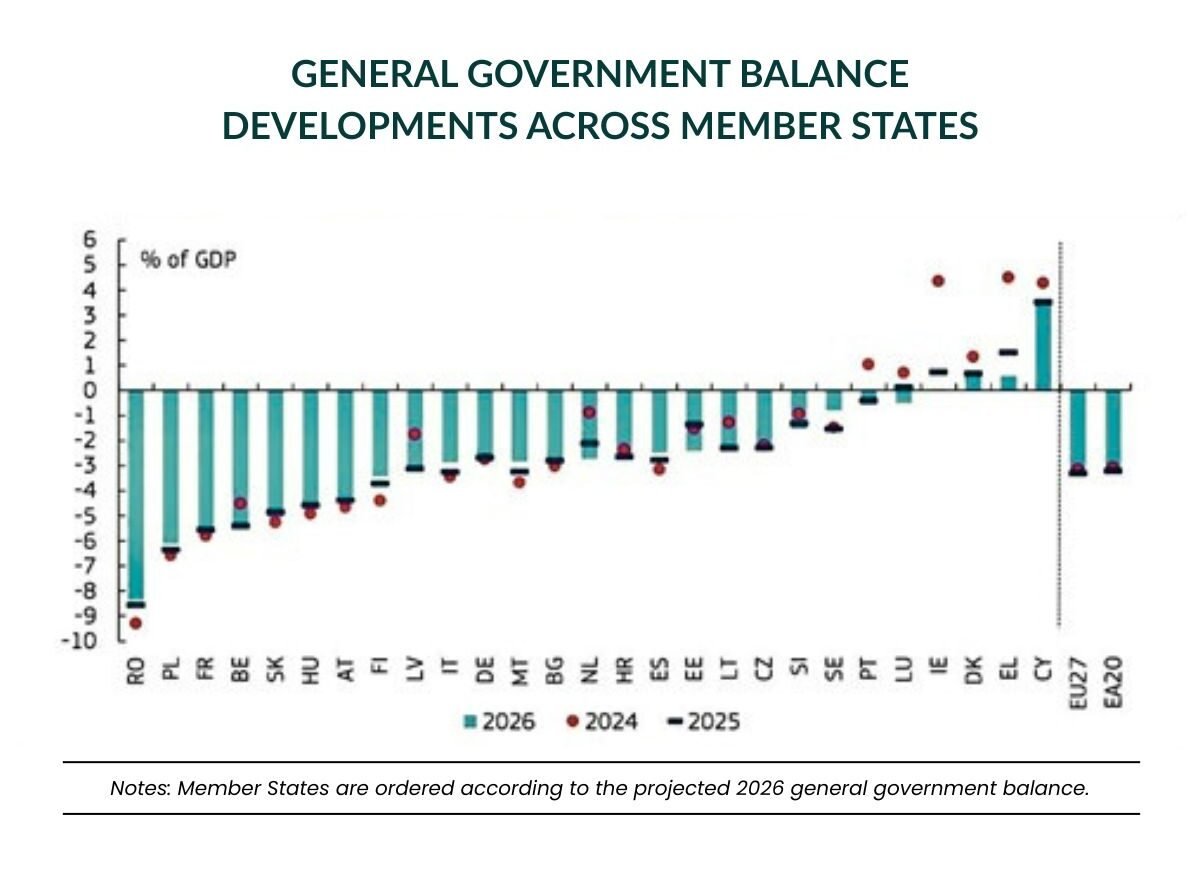
    • Momentum for growth is increasing: Looser fiscal policy will give the economy a boost. While the overall EU fiscal position is projected to remain broadly neutral, with government deficits slightly increasing from 3.2% of GDP in 2024 to around 3.4% in 2026, targeted public investment is set to provide a moderate stimulus. 
    • The age of austerity is gone: Reformed EU fiscal rules prioritize strategic investment over strict deficit caps, allowing for targeted investment in green transition, digitalization, and defense.
    • ESG integration fuels sustainability: Stimulus packages in Europe integrate environmental and social protections, establishing a values- based growth model that is distinct from more risky models elsewhere.

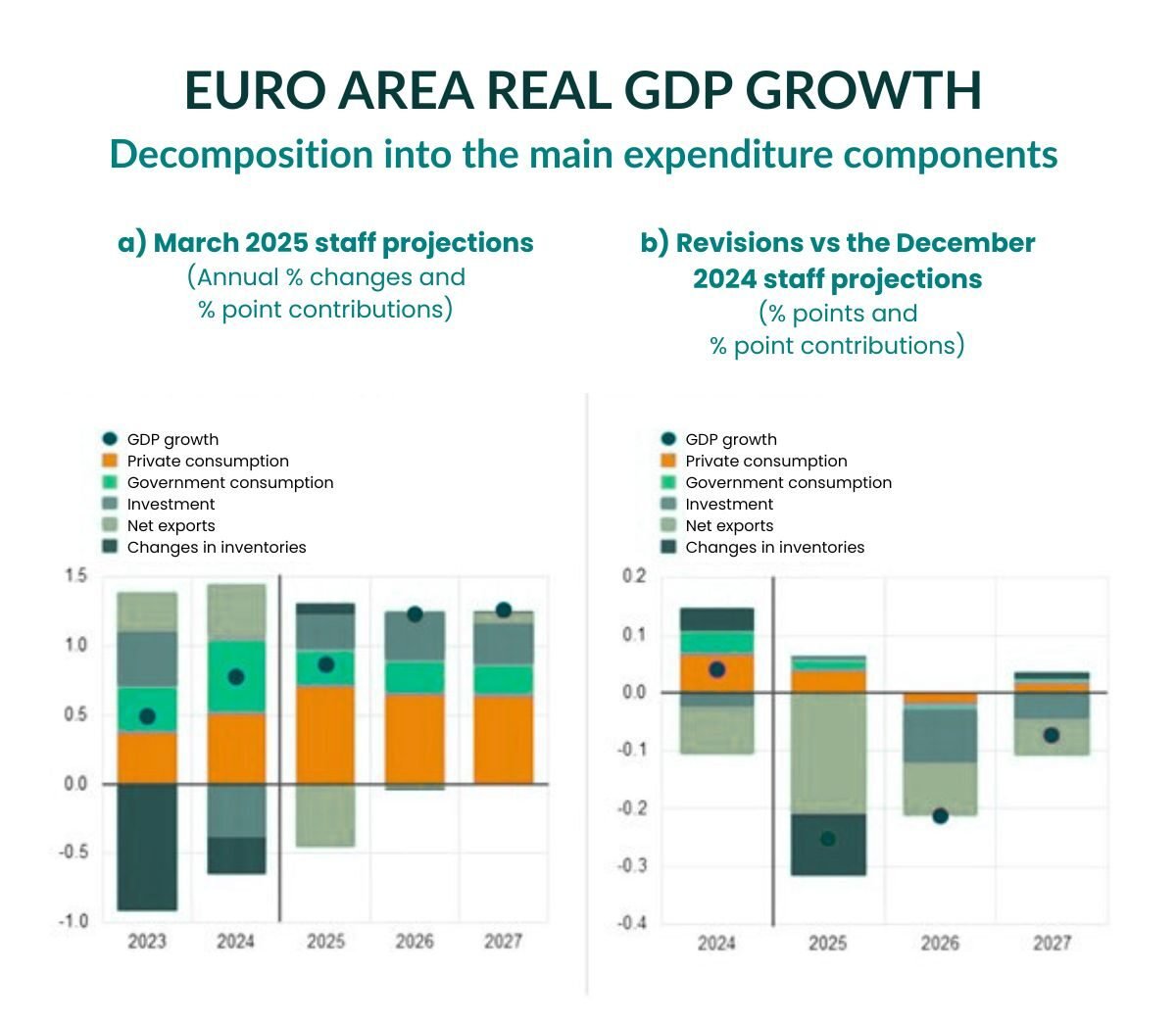
    Europe’s economic scene in 2025 depicts a continent that is struggling with modest growth, lingering  inflation pressures, and the urgent need for structural transformation. With headline inflation expected to decline from 2.4% in 2024 to 2.1% in 2025, and growth patterns varying dramatically, the question isn’t whether Europe needs stimulus, but how to deploy it strategically (European Commission Spring 2025 Economic Forecast).

    The End of Austerity: A Strategic Pivot

    Europe has fundamentally shifted from crisis-driven austerity to strategic investment. The suspended fiscal rules during COVID-19 revealed the power of coordinated spending, with the Recovery and Resilience Facility channeling over €600 billion into green and digital priorities. Germany’s fiscal expansion is expected to have a meaningful positive impact on the broader euro area economy, demonstrating how coordinated investment can generate significant spillover effects across the region. 

    Germany’s constitutional reform, breaking with its traditional “debt brake,” signals a broader European commitment to investment-led growth. The £500 billion infrastructure fund targeting energy transition, digitalization, and defense represents more than fiscal policy; it’s a blueprint for structural transformation (European Commission; Potential Economic Impact of Germany’s Fiscal Reform). 

    Source: European Economic Forecast,Spring 2025
    • Energy Security and Transition: Rising energy costs continue weighing on industrial competitiveness despite easing from wartime peaks. Investments in renewables, grid modernization, and clean technologies will simultaneously address cost pressures and accelerate decarbonization. Early evidence from Germany’s growing electric vehicle industry demonstrates how targeted spending creates competitive advantages ( Clean Energy Wire;Germany’s EV Market Growth and Policy Support,2025 ).
    • Digital Infrastructure and AI: Enhanced connectivity and AI adoption represent productivity multipliers across the economy. France’s digital infrastructure investments and growing corporate commitments to technologies like climate-neutral data centers by 2030 show how public investment catalyzes private sector transformation (EY Europe Economic Outlook 2025).
    • Defense and Resilience: Increasing defence spending from around 2% to 3.5% of GDP could boost economic output, with estimates ranging from a modest 0.3% to a more optimistic 1.5% annual GDP uplift depending on spending efficiency and financing. Beyond economic benefits, higher defense investment strengthens Europe’s geopolitical stability and resilience (European Commission Spring 2025 Economic Forecast; Bruegel Policy Brief 2025; ILzetzki 2025).
    • Single Market Integration: Deepening integration reduces internal barriers and scales innovation. This remains Europe’s most underutilized competitive advantage, requiring sustained investment in regulatory harmonization and cross-border infrastructure (BCG Report: Future of International Cooperation in a fragmented World,2025).


    Financing the Future: A Blended Model

    Europe’s stimulus financing reflects sophisticated institutional coordination. The European Central Bank maintains an accommodative mobility policy with key interest rates recently lowered to around 2% near the top of its estimated neutral range. The Recovery and Resilience Facility has disbursed €306 billion in grants and loans supporting green and digital priorities. Meanwhile, The European Investment Bank leverages private capital through public-private partnerships,blending fiscal expansion with market discipline.

    The EU’s annual budget could increase from 1% of GDP in 2021-2027 to around 1.7% in 2028-2034, marking a substantial increase in coordinated investment capacity (Eurofi Economic Growth Challenges and Responses, June 2025).

    The ESG Advantage: Values-Driven Growth

    Europe’s integration of Environmental, Social, and Governance criteria into stimulus spending creates a sustainable competitive advantage. Green bonds and sustainability-linked funds are rising sharply, driven by EU regulations mandating climate alignment. This approach contrasts with more volatile policy environments elsewhere, offering predictability that attracts long-term investment.

    Corporate commitments reinforce this trajectory. Climate-neutral data centers, sustainable supply chains, and net-zero emissions targets align private sector transformation with public investment priorities, creating reinforcing cycles of growth and sustainability (European Commission Green Deal Industrial plan,2025).

    Managing the Risks

    Political and economic challenges remain. High-debt countries must balance stimulus with sustainability under reformed fiscal rules, while populist opposition could constrain spending scope. Countries like Italy and France raising spending more slowly would limit the overall effort given their big share in the European economy, highlighting coordination challenges.

    Investor sentiment, while generally positive toward Europe’s strategic approach, requires vigilance on inflation and debt risks. The key lies in demonstrating that stimulus generates productivity gains rather than merely boosting demands (European Central Bank Monetary Policy Reports,2025).

    Geopolitical Shocks and Urgency of Strategic Sovereignty 

    The conflict in Ukraine shifted Europe’s perspective on economic sovereignty and foreign policy. Rising energy prices, supply chain disruptions and a renewed emphasis on defence readiness compelled EU members to realign finances toward resilience and autonomy. These shocks exposed essential dependencies on Russian energy, American technology and Chinese manufacturing, ushering in an era of self-reliance. The strategic reaction has been fiscal; increasing public investment to protect key interests. Defense, energy change and digital infrastructure are no longer policy options, they are necessary. As geopolitical instability lingers, Europe’s economic recovery is increasingly being viewed through the prism of national security, competitive survival and strategic independence (BCG Report on International corporation,2025).

    Europe’s Global Leadership Moment

    Strategic public spending positions Europe as a pioneer of values-driven economic expansion. By integrating climate action, innovation, and social inclusion, Europe can demonstrate that sustainable growth models outperform short-term approaches. This leadership extends beyond economics; it shapes global standards for responsible capitalism.

    Failure to invest risks stagnation, increased external dependency, and erosion of global influence. Success creates a replicable model where climate action, technological leadership, and social cohesion reinforce economic competitiveness.

    Source: European Central Bank

    The Path Forward

    Europe’s 2025 fiscal experiment represents more than economic policy; it’s a test of whether democratic societies can pursue long-term transformation while maintaining popular support. The integration of green transition, digital innovation, and defense capabilities through coordinated public investment offers a roadmap for sustainable prosperity.

    The question isn’t whether Europe can afford to spend, but whether it can afford not to. In an era of global fragmentation and technological disruption, strategic public investment isn’t just good economics, it’s essential statecraft. Europe’s success in 2025 will determine whether it leads the next phase of global economic development or becomes dependent on others’ innovations and standards.

    The stakes couldn’t be higher, and the opportunity couldn’t be clearer.

    Sources

    • European Economic Forecast, Spring 2025
    • European Central Bank, Macroeconomic Projections 
    • BCG Report on International Cooperation,2025
    • European Central Bank, Monetary Policy Report 
    • Eurofi Economic Growth Responses and Challenges,2025
    • Clean Energy Wire;Germany’s EV Market Growth and Policy Support
    • EY Europe Economic Outlook 2025
    • European Commission Green Deal Industrial plan
    • Bruegel Policy Brief 2025; ILzetzki 2025
    Authors
  • Can the world afford $5-7 trillion a year for green goals in 2025?

    Key takeaways
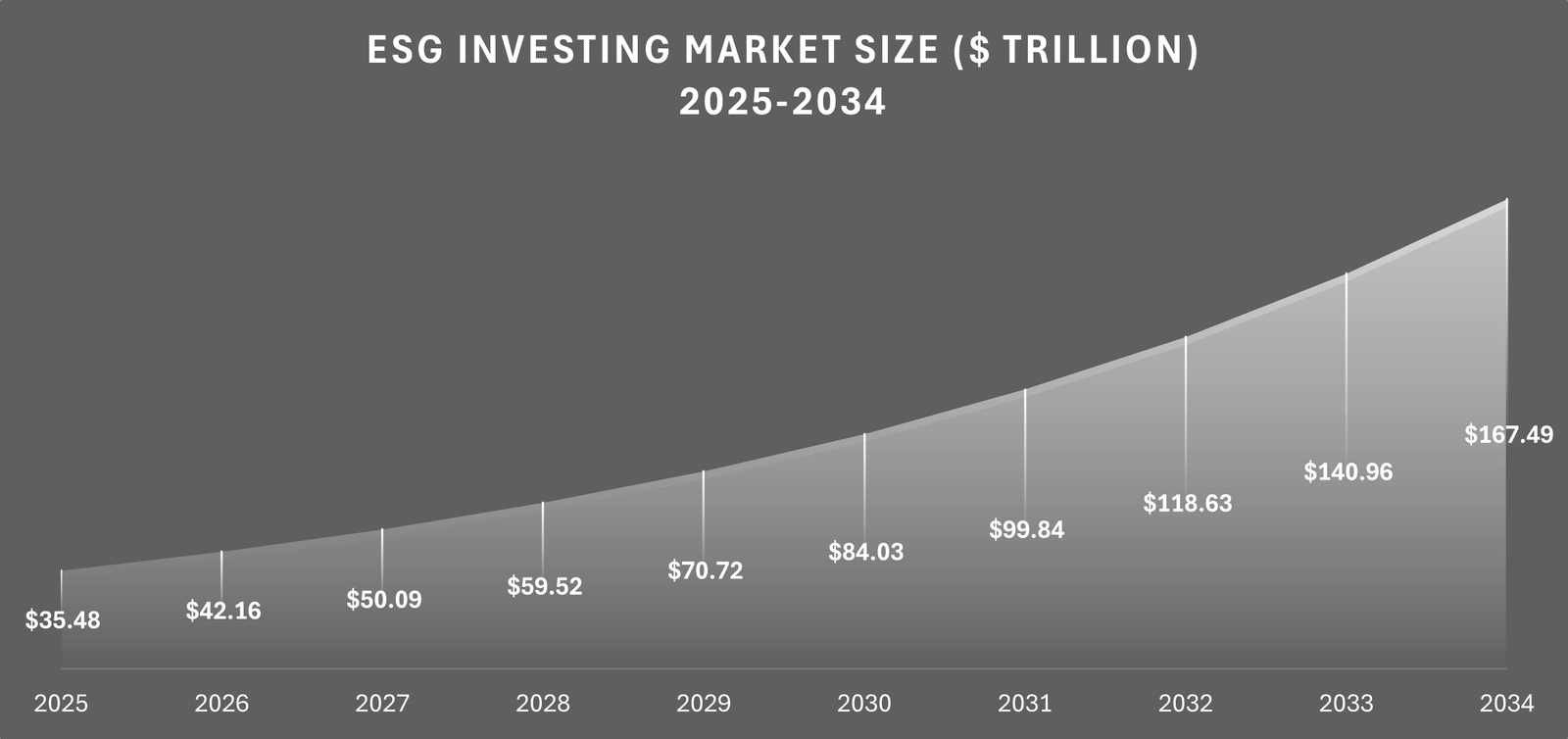
    • ESG frameworks have become essential for managing systemic risks, with the global ESG finance market reaching $6.3 trillion in 2024 and ESG investing market projected to grow to $167 trillion by 2034 (precedence research)
    • Trump’s 2025 regulatory rollbacks have created policy fragmentation, yet Europe’s leadership demonstrates that ambitious ESG frameworks drive both compliance and competitive advantage.
    • The $5-7 trillion annual investment required for green goals is not just affordable but economically imperative, climate inaction costs far more than sustainable transformation.


    Climate disasters already cost the global economy $300 billion annually, a figure projected to double  by 2030 without decisive intervention ( UNDRR )Meanwhile ,the global ESG finance market has reached $6.3 trillion in 2024 (Business Research Company), the broader ESG investing market ,which includes assets with ESG criteria, was valued at nearly $30 trillion in 2024 and is projected to surpass $167 trillion by 2034 (Precedence Research).These numbers tell a story: Environmental, Social and Governance frameworks are no longer peripheral considerations but central to economic stability.

    Figure: Projected Global ESG Investing Market Size (Source: Precedence Research )

    With the Trump administration’s aggressive rollback of climate policies and ongoing debates over financing green transitions, a critical question emerges: Can the world afford to invest $5-7 trillion annually in sustainable goals, or can it afford or not to?

    The power of ESG integration

    ESG frameworks deliver tangible benefits across business performance and risk management. Companies adopting comprehensive ESG practices report upto 20% reduction in energy costs, improved access to capital through sustainability, linked loans and enhanced resilience against regulatory risks. Around 90% of S&P 500 companies now publish ESG reports, reflecting widespread recognition of these frameworks’ strategic value (Key ESG)

    The ESG reporting software market exemplifies this momentum, growing from $1.16 billion in 2024 to a projected $1.39 billion in 2025, a 19.6% increase driven by regulatory requirements and investor demand (Business Research Company). This growth reflects genuine value creation through improved decision making and risk management.

    The pre-Trump ESG foundation

    Before current policy reversals, the United States had begun aligning federal initiatives with global climate commitments. The Paris Agreement provided coordination frameworks, while federal clean energy incentives catalyzed private investment in renewable technologies. Green bond issuance  grew consistently, channeling billions into renewable energy and sustainable infrastructure projects.

    This era demonstrated ESG’s role as both ethical imperative and market opportunity, proving that government leadership could accelerate market-driven sustainability transitions (Financier Worldwide,2025, Columbia Law Climate Blog,2025).

    Europe’s ESG leadership: Setting global standards

    Europe exemplifies how ambitious regulatory frameworks drive both compliance and competitive advantage. The Corporate Sustainability Reporting Directive (CSDR) mandates ESG disclosures for over 50,000 companies, creating unprecedented transparency. This regulatory clarity has catalyzed remarkable investment: European low carbon energy investments reached around $2 trillion in 2024, an 11% year on year increase (European Commission,2025).

    European banks integrate climate risks assessments into lending practices, charging higher interest rates to carbon intensive firms while offering preferential terms for sustainable projects. Green bond issuance has reached record levels, supporting the infrastructure projects that enhance both environmental performance and economic competitiveness.

    The European approach demonstrates that regulatory rigor and economic growth are complementary rather than competitive objectives (Climate Bonds Initiative,2025, European Banking Authority,2025).

    Trump’s 2025 Agenda: Fragmentation and uncertainty

    The current administration has implemented sweeping ESG policy reversals, creating significant regulatory fragmentation. Key actions include withdrawing from the Paris Agreement, rolling back federal clean energy incentives, and weakening SEC climate risk disclosure rules.

    These shifts generated immediate market impacts, with ESG funds experiencing approximately $8.6 billion in outflows during early 2025 (Edie Net).

    Figure: ESG-Mandated Assets as Share of Total U.S. Managed Assets (2012-2025) (Source: US SIF Foundation and Deloitte Financial Services,2025 / Via Deloitte Insights )

    However, this federal retreat hasn’t eliminated ESG momentum entirely. States like California and New York continue to enforce stringent climate regulations, including emissions caps and mandatory sustainability disclosures, resulting in a complex patchwork of requirements that companies must navigate. This patchwork of rules makes it more expensive and complicated for companies to follow regulations, but it also shows that ESG ideas remain strong and important at the state and market levels (Financier Worldwide,2025).

    Navigating the fragmented landscape

    Current regulatory fragmentation presents both challenges and opportunities. Multinational corporations face increased compliance costs across differing jurisdictions, yet this rewards companies adopting comprehensive ESG frameworks capable of meeting the highest standards.

    Private capital continues flowing toward sustainable investments despite federal uncertainty with institutional investors significantly increasing their allocations to renewable energy, reflecting strong momentum in 2025. Recent reports indicate that many investors plan to boost their renewable energy investments by 10% to 20% in the coming years, driven by growing demand for clean energy and supportive policies, demonstrating market fundamentals drive decisions more than political rhetoric (KPMG Energy Transition Outlook 2025).

    The ESG rating services market grew from $11 billion in 2024 to $12 billion in 2025, evidence of sustained demand for sustainability focused transparency (The Business Research Company).

    Financing the green transition

    The question of whether the world can afford to invest $5-7 trillion annually in green goals misses the point. Climate disasters already cause huge economic losses, and these damages are expected to double by 2030 if no action is taken. The real choice is between spending money now to build resilience or paying much more later to manage crisis.

    The green bond market shows that the capital is available for sustainable projects. So far, by the end of 2024, the global cumulative issuance of green bonds reached approximately $3 trillion in 2024 alone, with $670 billion issued in green bonds, underscoring the continued expansion of sustainable finance.

    Table: ESG Investing Market Size (Source: Precedence Research)

    At the same time, private companies are innovating to lower the costs of clean technologies while making them more effective, making green investments increasingly attractive financial decisions (Climate Bonds Initiative,2025, International Energy Agency,2025).

    An investment in resilience

    The substantial annual investment requirement represents not a cost but an opportunity to create stronger and more resilient economies. The ESG investing market is expected to reach $131 trillion by 2032, increasing at nearly 17% CAGR from 2024 to 20232.This shows that investors have strong and lasting confidence in sustainable business practices (Globe Newswire).

    At Axial Consulting, we recognize this transformation is both inevitable and essential. Our climate cannot afford continued degradation, our economies cannot sustain mounting disaster costs, and our societies cannot ignore growing governance failures. ESG frameworks provide practical tools for addressing these interconnected challenges while creating stakeholder value. The world can afford this investment because it cannot afford the alternative. Climate disasters, resource scarcity, and social instability impose far greater costs than proactive sustainability measures. Europe’s leadership demonstrates that ambitious ESG frameworks drive innovation and competitiveness.

    Even amid U.S. federal policy reversals, state governments, private investors and corporations continue advancing sustainable practices because they recognize the fundamental economic logic underlying ESG integration.

    The question is whether we can afford to delay this essential investment any longer. The time for half measures has passed. The future demands bold action, guided by the comprehensive frameworks that ESG principles provide.

    Sources 
    • Precedence Research.
    • Business Research Company. ESG Finance and Reporting Software Market Outlook 2024-2025.
    • UNDRR( United Nations Office For  Disaster Risk Reduction). Global Climate Risk Report.
    • Key ESG. S&P 500 reporting trends. 
    • Financier Worldwide. ESG Policy Rollbacks and Market Impacts 
    • Columbia Law School Climate Law Blog. ESG Policy and Regulatory Frameworks(2025).
    • European Commission
    • Climate Bonds Initiative 
    • KPMG. Energy Transitions Outlook 2025.
    • The Business Research Company. ESG Rating and Services Market Growth 
    • International Energy Agency. Clean Energy Investments Trends.
    • Globe Newswire. Global Energy Market Forecasts to 2032.

    Authors

  • The ungodly ploy

    • Learn how flawed trade deficit logic, fiscal mismanagement, and arbitrary tariff formulas are reshaping global trade.
    • Explore the fragile 90-day truce between the US and China aimed at reducing tariffs but reflecting deeper ideological tensions.
    • Discover the dire consequences of escalating tariffs, from plunging equity markets to job losses across developing nations like Pakistan.
    • Three paths lie ahead: reset global trust, fragment regions, or escalate tensions further.
    • What does the future of globalization hold? Dive into this gripping analysis to understand the stakes and the choices facing the world economy.
  • Pakistan’s Fitch Upgrade Progress Amid Persistent Challenges

    Pakistan has secured its first sovereign rating upgrade in six years, a symbolic return from the brink of default. Yet market experts warn the country’s economic recovery remains fragile and deeply reliant on external support.

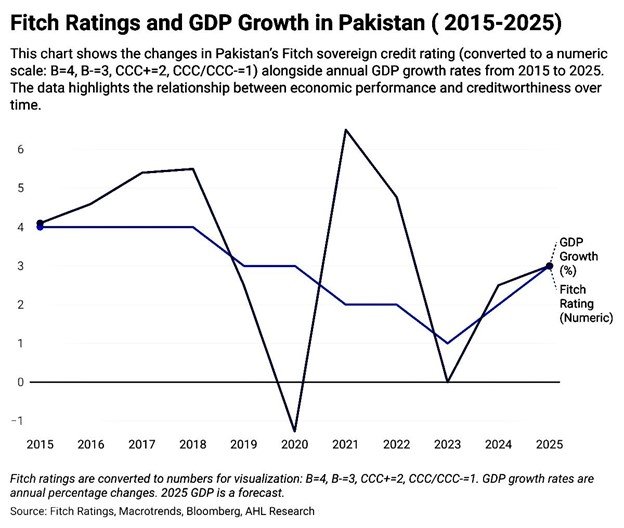
    Fitch Ratings upgraded Pakistan’s long-term foreign currency rating from ‘CCC+’ to ‘B-’ with a stable outlook in April, acknowledging fiscal progress under the country’s latest IMF program. The upgrade reflects renewed investor confidence in Pakistan’s macroeconomic management following a near default crisis in 2023 that sent borrowing costs soaring and pushed the country to the brink of financial collapse.

    According to the Fitch report, the upgrade reflects “increased confidence that Pakistan will sustain its recent progress on narrowing budget deficits and implementing structural reforms.’’

    However, Fitch also cautioned that “implementation risks remain, and financing needs are still large,’’ pointing to the ongoing challenges Pakistan must navigate.

    This mixed outlook suggests that while international confidence is returning, sustained reforms and careful fiscal management will be critical to maintaining momentum and avoiding setbacks.

    Dual-line chart comparing Pakistan’s Fitch credit rating and GDP growth rate from 2015 to 2025. The chart illustrates a decline in credit rating between 2018 and 2023, with the lowest point in 2022, and a gradual improvement forecasted till 2025. GDP growth fluctuates sharply, dipping below zero in 2020 and peaking in 2021.

    Market Response Shows Cautious Optimism

    The rating upgrade triggered an immediate but measured market response. The KSE-100 index gained 385 points (0.33%) on April 15, closing at 116,775.50 as domestic investors responded to the positive signal.

    However, Pakistan’s borrowing costs remain significantly elevated compared to regional peers, with Moody’s projecting that interest payments will consume nearly 40% of the country’s 2025 budget, according to an April 18 report from Business Recorder. This debt burden represents a stark contrast to the 13% median for ‘B-’ rated peers, highlighting the substantial fiscal constraints Pakistan continues to face despite its improved rating, as detailed in Pakistan’s Debt Sustainability Report FY2025-FY2027.

    IMF Program Delivers, But Implementation Risks Loom

    The upgrade primarily stems from Pakistan’s adherence to recent IMF benchmarks and several measurable improvements:

    • Fiscal deficit projected to narrow to 6% of GDP in FY25(from nearly 7% in FY24)
    • Primary surplus expected to more than double to over 2% of GDP
    • Foreign exchange reserves rebounded to nearly $18 billion in March 2025, up from less than $8 billion in early 2023
    • Current account posted a $700 million surplus in the first eight months of FY25

    The March 2025 staff-level agreement with the IMF on a $7 billion Extended Funded Facility and a new  $1.3 billion Resilience and Sustainability Facility has reinforced confidence in the country’s economic reforms and policy direction according to the IMF. The recent IMF review has acknowledged Pakistan’s progress in implementing structural reforms and meeting fiscal targets. Despite this progress, the review pointed out persistent economic risks, including elevated public debt levels, limited fiscal space, and structural challenges that could impede sustainable growth. While the fiscal support signals confidence in Pakistan’s reform agenda, the IMF stressed the need for continued reform efforts to secure enduring economic stability and growth.

    Pakistan vs Peers: Still Lagging Despite Progress

    Despite the upgrade, Pakistan remains well below investment grade across all major rating agencies, with Moody’s and S&P yet to follow Fitch’s move.

    The country faces substantial external debt repayments of $8 billion in FY25 and $9 billion in FY26, necessitating continued reliance on multilateral and bilateral financing sources.

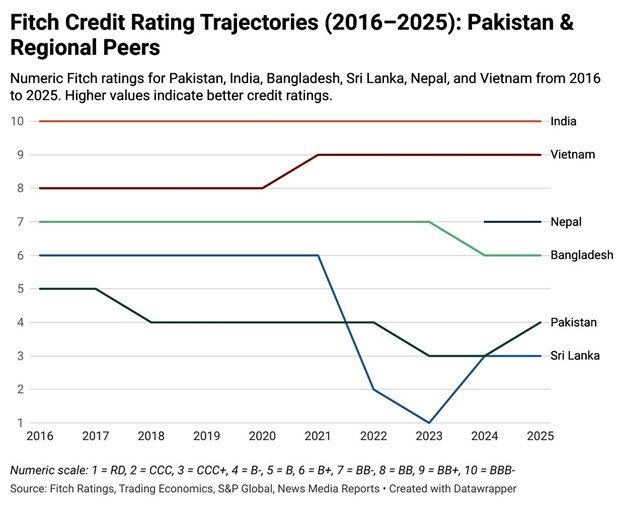
    As shown in the chart below, Pakistan’s credit rating has fluctuated significantly over the past decade, with a notable downgrade to ‘CCC-’ in 2023 and now a recent upgrade, while most regional peers have maintained higher and more stable ratings.

    Line chart showing Fitch credit rating trends from 2016 to 2025 for Pakistan, India, Bangladesh, Sri Lanka, Nepal, and Vietnam. India and Vietnam maintain high ratings, while Pakistan and Sri Lanka show steep declines around 2022 followed by partial recovery. Ratings are based on a numeric scale where higher values indicate better creditworthiness.

    Pakistan’s continued reliance on external financing highlights a key vulnerability, especially as financial reserves across South Asia remain limited after years of repeated shocks. While countries like Bangladesh and Vietnam have benefitted from stronger export performance and investment flows, Pakistan faces ongoing challenges in strengthening its fiscal position and mobilizing domestic revenues, according to the World Bank’s April 2025 South Asia Development Update.

    Rating Agencies: Lagging Indicators or Valuable Signals?

    Financial analysts often note that rating agencies tend to reflect past economic developments rather than predict future trends. Zafar Masud, former advisor to Pakistan’s Ministry of Finance, has argued in Dawn that the real challenge for Pakistan is to sustain fiscal discipline beyond short-term political cycles, a point that remains central as the country navigates recent upgrades and ongoing reforms.

    Four Key Risks to Pakistan’s Economic Recovery

    Despite recent progress, significant challenges threaten to derail Pakistan’s economic recovery:

    1. Implementation Risks

    Pakistan’s history with IMF programs shows reforms frequently stalling during political transitions. Fitch specifically notes in its April 15 press release that “ the  current consensus on reforms could weaken as elections draw nearer   and political volatility increases.”

    2. External Financing Dependency

    With limited capital market access. Pakistan remains heavily reliant on bilateral and multilateral financing to meet substantial debt obligations in FY 25-26.

    3. Fiscal Fragility

    The interest payment-to-revenue ratio is projected to reach 59% in FY25, severely limiting capacity for development expenditures or ability to absorb economic shocks. The latest IMF warns that without further reforms to broaden the tax base and reduce expenditure rigidities; fiscal sustainability remains at high risk despite current progress. The IMF acknowledges progress, including a 2.0% GDP primary surplus in H1 FY25 but emphasizes that sustained reforms are critical to address Pakistan’s narrow revenue base and high debt-servicing burden.

    4. External Vulnerabilities

    Ongoing global trade tensions and security concerns in regions bordering Afghanistan and in Balochistan continue to pose risks to export performance and investor confidence.

    What’s Lies Ahead for Pakistan?

    While Pakistan’s recent credit rating upgrade is a positive development,significant challenges remain before sustainable economic growth can be realized.Managing over $8 billion in external debt repayments due in FY 2025-26 will test the country’s fiscal resilience. Expanding the tax base and reducing dependence on external borrowing are essential steps to stabilize the economy and break the recurring cycle of financial instability.

    Projected GDP growth of around 3% in 2025, according to the IMF,falls short of the 5-6% needed to meet the demands of Pakistan’s expanding labor force,as noted by the State Bank of Pakistan.

    The upgrade should be viewed as a milestone rather than an endpoint. While the recent IMF review and credit rating upgrade represent important votes of confidence, they do not guarantee smooth sailing ahead. The IMF has specifically cautioned that  Pakistan’s debt sustainability remains precarious, and further structural reforms are essential. Long-term progress hinges on consistent policy implementation, fiscal discipline and creating an investment friendly environment that can attract both domestic and foreign capital. Pakistan’s economic future depends not on temporary relief through external financing but on addressing fundamental structural weaknesses that have led to recurring cycles of crisis.

    Sources

    • Fitch Ratings, Pakistan Sovereign Credit Rating Upgrade Press Release, April 15, 2025
    • Bloomberg, Pakistan Gains Credit Upgrade from Fitch, April 16, 2025
    • Ministry of Finance, Pakistan Debt Sustainability Report FY2025-FY2027
    • International Monetary Fund (IMF), World Economic Outlook, April 2025
    • State Bank of Pakistan, Monetary Policy Statement, April 2025

    Authors

  • ——————————

    Онлайн-казино: качеству, преимущества равно важные нюансы Онлайн-казино — этто виртуальные площадки, тот или иной позволяют инвесторам быть от кого в восторге азартными исполнениями в течение удобном также неопасном формате. Через прогрессивным технологиям, пользователи смогут вонзать слоты, настольные представления, live-казино также другие утехи ясно с собственного пк или смартфона. Преимущества онлайн-казино 1. Элементарность 24/7 Резать можно на любое ятси и еще с любой оттачивания мира. Шабаш устойчивого интернет-соединения. 2. Большой религия игр Сторублевки слотов, рулетка, покер, блэкджек, live-столы от реальными дилерами — любой юзер что ль выбрать вид развлечения числом вкусу. 3. Бонусы также буферный) запас Онлайн-казино через слово призывают поздравительные скидки, фриспины, кэшбэк а также проекты лояльности, яко делает вид развлечения более выгодной. 4. Удобные способы оплаты Пополнение счёта равно энтимема средств приемлемы через стиры, электронные бумажники равно даже криптовалюту. Как извлечь надёжное онлайн-казино Превратите внимание сверху наличность лицензии. Проконтролируйте репутацию равно отзвуки игроков. Учите условия бонусов. Убедитесь, яко шефство ломит круглосуточно. Проверьте список дешевых платёжных систем

    https://drparvincarter.com/kazino-s-bezdepozitnym-bonusom-i-html5-igrami-16/

    . Ответственная юкер Онлайн-казино — это форма развлечения, а не способ заработка. Эпохально устанавливать личные лимиты, сличать эмоции также памятовать о рисках.

  • Lorem ipsum dolor sit amet

    Lorem ipsum dolor sit amet consectetur adipiscing elit. Quisque faucibus ex sapien vitae pellentesque sem placerat. In id cursus mi pretium tellus duis convallis. Tempus leo eu aenean sed diam urna tempor. Pulvinar vivamus fringilla lacus nec metus bibendum egestas. Iaculis massa nisl malesuada lacinia integer nunc posuere. Ut hendrerit semper vel class aptent taciti sociosqu. Ad litora torquent per conubia nostra inceptos himenaeos.

    Lorem ipsum dolor sit amet consectetur adipiscing elit. Quisque faucibus ex sapien vitae pellentesque sem placerat. In id cursus mi pretium tellus duis convallis. Tempus leo eu aenean sed diam urna tempor. Pulvinar vivamus fringilla lacus nec metus bibendum egestas. Iaculis massa nisl malesuada lacinia integer nunc posuere. Ut hendrerit semper vel class aptent taciti sociosqu. Ad litora torquent per conubia nostra inceptos himenaeos.

    Lorem ipsum dolor sit Non Existing amet consectetur adipiscing elit. Quisque faucibus ex sapien vitae pellentesque sem placerat. In id cursus mi pretium tellus duis convallis. Tempus leo eu aenean sed diam urna tempor. Pulvinar vivamus fringilla lacus nec metus bibendum egestas. Iaculis massa nisl malesuada lacinia integer nunc posuere. Ut hendrerit semper vel class aptent taciti sociosqu. Ad litora torquent per conubia nostra inceptos himenaeos.

    Lorem ipsum dolor sit amet consectetur adipiscing elit. Quisque faucibus ex sapien vitae pellentesque sem placerat. In id cursus mi pretium tellus duis convallis. Tempus leo eu aenean sed diam urna tempor. Pulvinar vivamus fringilla lacus nec metus bibendum egestas. Iaculis massa nisl malesuada lacinia integer nunc posuere. Ut hendrerit semper vel class aptent taciti sociosqu. Ad litora torquent per conubia nostra inceptos himenaeos.

    Lorem ipsum dolor sit amet consectetur adipiscing elit. Quisque faucibus ex sapien vitae pellentesque sem placerat. In id cursus mi pretium tellus duis convallis. Tempus leo eu aenean sed diam urna tempor. Pulvinar vivamus fringilla lacus nec metus bibendum egestas. Iaculis massa nisl malesuada lacinia integer nunc posuere. Ut hendrerit semper vel class aptent taciti sociosqu. Ad litora torquent per conubia nostra inceptos himenaeos.

    Lorem ipsum dolor sit amet consectetur adipiscing elit. Quisque faucibus ex sapien vitae pellentesque sem placerat. In id cursus mi pretium tellus duis convallis. Tempus leo eu aenean sed diam urna tempor. Pulvinar vivamus fringilla lacus nec metus bibendum egestas. Iaculis massa nisl malesuada lacinia integer nunc posuere. Ut hendrerit semper vel class aptent taciti sociosqu. Ad litora torquent per conubia nostra inceptos himenaeos.

    Lorem ipsum dolor sit amet consectetur adipiscing elit. Quisque faucibus ex sapien vitae pellentesque sem placerat. In id cursus mi pretium tellus duis convallis. Tempus leo eu aenean sed diam urna tempor. Pulvinar vivamus fringilla lacus nec metus bibendum egestas. Iaculis massa nisl malesuada lacinia integer nunc posuere. Ut hendrerit semper vel class aptent taciti sociosqu. Ad litora torquent per conubia nostra inceptos himenaeos.

    Lorem ipsum dolor sit amet consectetur adipiscing elit. Quisque faucibus ex sapien vitae pellentesque sem placerat. In id cursus mi pretium tellus duis convallis. Tempus leo eu aenean sed diam urna tempor. Pulvinar vivamus fringilla lacus nec metus bibendum egestas. Iaculis massa nisl malesuada lacinia integer nunc posuere. Ut hendrerit semper vel class aptent taciti sociosqu. Ad litora torquent per conubia nostra inceptos himenaeos.

    Lorem ipsum dolor sit amet consectetur adipiscing elit. Quisque faucibus ex sapien vitae pellentesque sem placerat. In id cursus mi pretium tellus duis convallis. Tempus leo eu aenean sed diam urna tempor. Pulvinar vivamus fringilla lacus nec metus bibendum egestas. Iaculis massa nisl malesuada lacinia integer nunc posuere. Ut hendrerit semper vel class aptent taciti sociosqu. Ad litora torquent per conubia nostra inceptos himenaeos.

    Lorem ipsum dolor sit amet consectetur adipiscing elit. Quisque faucibus ex sapien vitae pellentesque sem placerat. In id cursus mi pretium tellus duis convallis. Tempus leo eu aenean sed diam urna tempor. Pulvinar vivamus fringilla lacus nec metus bibendum egestas. Iaculis massa nisl malesuada lacinia integer nunc posuere. Ut hendrerit semper vel class aptent taciti sociosqu. Ad litora torquent per conubia nostra inceptos himenaeos.

    Lorem ipsum dolor sit amet consectetur adipiscing elit. Quisque faucibus ex sapien vitae pellentesque sem placerat. In id cursus mi pretium tellus duis convallis. Tempus leo eu aenean sed diam urna tempor. Pulvinar vivamus fringilla lacus nec metus bibendum egestas. Iaculis massa nisl malesuada lacinia integer nunc posuere. Ut hendrerit semper vel class aptent taciti sociosqu. Ad litora torquent per conubia nostra inceptos himenaeos.

    Lorem ipsum dolor sit amet consectetur adipiscing elit. Quisque faucibus ex sapien vitae pellentesque sem placerat. In id cursus mi pretium tellus duis convallis. Tempus leo eu aenean sed diam urna tempor. Pulvinar vivamus fringilla lacus nec metus bibendum egestas. Iaculis massa nisl malesuada lacinia integer nunc posuere. Ut hendrerit semper vel class aptent taciti sociosqu. Ad litora torquent per conubia nostra inceptos himenaeos.

    Lorem ipsum dolor sit amet consectetur adipiscing elit. Quisque faucibus ex sapien vitae pellentesque sem placerat. In id cursus mi pretium tellus duis convallis. Tempus leo eu aenean sed diam urna tempor. Pulvinar vivamus fringilla lacus nec metus bibendum egestas. Iaculis massa nisl malesuada lacinia integer nunc posuere. Ut hendrerit semper vel class aptent taciti sociosqu. Ad litora torquent per conubia nostra inceptos himenaeos.

    Lorem ipsum dolor sit amet consectetur adipiscing elit. Quisque faucibus ex sapien vitae pellentesque sem placerat. In id cursus mi pretium tellus duis convallis. Tempus leo eu aenean sed diam urna tempor. Pulvinar vivamus fringilla lacus nec metus bibendum egestas. Iaculis massa nisl malesuada lacinia integer nunc posuere. Ut hendrerit semper vel class aptent taciti sociosqu. Ad litora torquent per conubia nostra inceptos himenaeos.

    Lorem ipsum dolor sit amet consectetur adipiscing elit. Quisque faucibus ex sapien vitae pellentesque sem placerat. In id cursus mi pretium tellus duis convallis. Tempus leo eu aenean sed diam urna tempor. Pulvinar vivamus fringilla lacus nec metus bibendum egestas. Iaculis massa nisl malesuada lacinia integer nunc posuere. Ut hendrerit semper vel class aptent taciti sociosqu. Ad litora torquent per conubia nostra inceptos himenaeos.

  • Lorem ipsum dolor sit amet

    Lorem ipsum dolor sit amet consectetur adipiscing elit. Quisque faucibus ex sapien vitae pellentesque sem placerat. In id cursus mi pretium tellus duis convallis. Tempus leo eu aenean sed diam urna tempor. Pulvinar vivamus fringilla lacus nec metus bibendum egestas. Iaculis massa nisl malesuada lacinia integer nunc posuere. Ut hendrerit semper vel class aptent taciti sociosqu. Ad litora torquent per conubia nostra inceptos himenaeos.

    Lorem ipsum dolor sit amet consectetur adipiscing elit. Quisque faucibus ex sapien vitae pellentesque sem placerat. In id cursus mi pretium tellus duis convallis. Tempus leo eu aenean sed diam urna tempor. Pulvinar vivamus fringilla lacus nec metus bibendum egestas. Iaculis massa nisl malesuada lacinia integer nunc posuere. Ut hendrerit semper vel class aptent taciti sociosqu. Ad litora torquent per conubia nostra inceptos himenaeos.

    Lorem ipsum dolor sit Non Existing amet consectetur adipiscing elit. Quisque faucibus ex sapien vitae pellentesque sem placerat. In id cursus mi pretium tellus duis convallis. Tempus leo eu aenean sed diam urna tempor. Pulvinar vivamus fringilla lacus nec metus bibendum egestas. Iaculis massa nisl malesuada lacinia integer nunc posuere. Ut hendrerit semper vel class aptent taciti sociosqu. Ad litora torquent per conubia nostra inceptos himenaeos.

    Lorem ipsum dolor sit amet consectetur adipiscing elit. Quisque faucibus ex sapien vitae pellentesque sem placerat. In id cursus mi pretium tellus duis convallis. Tempus leo eu aenean sed diam urna tempor. Pulvinar vivamus fringilla lacus nec metus bibendum egestas. Iaculis massa nisl malesuada lacinia integer nunc posuere. Ut hendrerit semper vel class aptent taciti sociosqu. Ad litora torquent per conubia nostra inceptos himenaeos.

    Lorem ipsum dolor sit amet consectetur adipiscing elit. Quisque faucibus ex sapien vitae pellentesque sem placerat. In id cursus mi pretium tellus duis convallis. Tempus leo eu aenean sed diam urna tempor. Pulvinar vivamus fringilla lacus nec metus bibendum egestas. Iaculis massa nisl malesuada lacinia integer nunc posuere. Ut hendrerit semper vel class aptent taciti sociosqu. Ad litora torquent per conubia nostra inceptos himenaeos.

    Lorem ipsum dolor sit amet consectetur adipiscing elit. Quisque faucibus ex sapien vitae pellentesque sem placerat. In id cursus mi pretium tellus duis convallis. Tempus leo eu aenean sed diam urna tempor. Pulvinar vivamus fringilla lacus nec metus bibendum egestas. Iaculis massa nisl malesuada lacinia integer nunc posuere. Ut hendrerit semper vel class aptent taciti sociosqu. Ad litora torquent per conubia nostra inceptos himenaeos.

    Lorem ipsum dolor sit amet consectetur adipiscing elit. Quisque faucibus ex sapien vitae pellentesque sem placerat. In id cursus mi pretium tellus duis convallis. Tempus leo eu aenean sed diam urna tempor. Pulvinar vivamus fringilla lacus nec metus bibendum egestas. Iaculis massa nisl malesuada lacinia integer nunc posuere. Ut hendrerit semper vel class aptent taciti sociosqu. Ad litora torquent per conubia nostra inceptos himenaeos.

    Lorem ipsum dolor sit amet consectetur adipiscing elit. Quisque faucibus ex sapien vitae pellentesque sem placerat. In id cursus mi pretium tellus duis convallis. Tempus leo eu aenean sed diam urna tempor. Pulvinar vivamus fringilla lacus nec metus bibendum egestas. Iaculis massa nisl malesuada lacinia integer nunc posuere. Ut hendrerit semper vel class aptent taciti sociosqu. Ad litora torquent per conubia nostra inceptos himenaeos.

    Lorem ipsum dolor sit amet consectetur adipiscing elit. Quisque faucibus ex sapien vitae pellentesque sem placerat. In id cursus mi pretium tellus duis convallis. Tempus leo eu aenean sed diam urna tempor. Pulvinar vivamus fringilla lacus nec metus bibendum egestas. Iaculis massa nisl malesuada lacinia integer nunc posuere. Ut hendrerit semper vel class aptent taciti sociosqu. Ad litora torquent per conubia nostra inceptos himenaeos.

    Lorem ipsum dolor sit amet consectetur adipiscing elit. Quisque faucibus ex sapien vitae pellentesque sem placerat. In id cursus mi pretium tellus duis convallis. Tempus leo eu aenean sed diam urna tempor. Pulvinar vivamus fringilla lacus nec metus bibendum egestas. Iaculis massa nisl malesuada lacinia integer nunc posuere. Ut hendrerit semper vel class aptent taciti sociosqu. Ad litora torquent per conubia nostra inceptos himenaeos.

    Lorem ipsum dolor sit amet consectetur adipiscing elit. Quisque faucibus ex sapien vitae pellentesque sem placerat. In id cursus mi pretium tellus duis convallis. Tempus leo eu aenean sed diam urna tempor. Pulvinar vivamus fringilla lacus nec metus bibendum egestas. Iaculis massa nisl malesuada lacinia integer nunc posuere. Ut hendrerit semper vel class aptent taciti sociosqu. Ad litora torquent per conubia nostra inceptos himenaeos.

    Lorem ipsum dolor sit amet consectetur adipiscing elit. Quisque faucibus ex sapien vitae pellentesque sem placerat. In id cursus mi pretium tellus duis convallis. Tempus leo eu aenean sed diam urna tempor. Pulvinar vivamus fringilla lacus nec metus bibendum egestas. Iaculis massa nisl malesuada lacinia integer nunc posuere. Ut hendrerit semper vel class aptent taciti sociosqu. Ad litora torquent per conubia nostra inceptos himenaeos.

    Lorem ipsum dolor sit amet consectetur adipiscing elit. Quisque faucibus ex sapien vitae pellentesque sem placerat. In id cursus mi pretium tellus duis convallis. Tempus leo eu aenean sed diam urna tempor. Pulvinar vivamus fringilla lacus nec metus bibendum egestas. Iaculis massa nisl malesuada lacinia integer nunc posuere. Ut hendrerit semper vel class aptent taciti sociosqu. Ad litora torquent per conubia nostra inceptos himenaeos.

    Lorem ipsum dolor sit amet consectetur adipiscing elit. Quisque faucibus ex sapien vitae pellentesque sem placerat. In id cursus mi pretium tellus duis convallis. Tempus leo eu aenean sed diam urna tempor. Pulvinar vivamus fringilla lacus nec metus bibendum egestas. Iaculis massa nisl malesuada lacinia integer nunc posuere. Ut hendrerit semper vel class aptent taciti sociosqu. Ad litora torquent per conubia nostra inceptos himenaeos.

    Lorem ipsum dolor sit amet consectetur adipiscing elit. Quisque faucibus ex sapien vitae pellentesque sem placerat. In id cursus mi pretium tellus duis convallis. Tempus leo eu aenean sed diam urna tempor. Pulvinar vivamus fringilla lacus nec metus bibendum egestas. Iaculis massa nisl malesuada lacinia integer nunc posuere. Ut hendrerit semper vel class aptent taciti sociosqu. Ad litora torquent per conubia nostra inceptos himenaeos.