Category: consulting

  • Public vs Private Markets: How VC Exit Opportunities Shifted After 2024

    Post-2024 Liquidity Changes Reshape Exit Strategies for Founders and Investors

    The venture capital exit landscape is undergoing a profound transformation during the 2024-2025 period. What began as a post-pandemic rebound has evolved into a complex market reality where IPO windows remain tight, public valuations fluctuate sharply, and private market liquidity solutions rise in prominence. This evolution is reshaping how founders, investors, and capital markets navigate value realization, requiring new approaches to governance, capital efficiency, and exit strategy. The following analysis quantifies these shifts and explores their strategic implications across geographies and sectors.

    The Exit Landscape by the Numbers (2018–Mid-2025)

    The VC-backed IPO market collapsed from its 2021 peak of 193 deals to just 40-42 annually through 2024, the lowest level since 2011. For 2025, projections suggest modest recovery to 51-61 IPOs, with H1 2025 tracking toward approximately 21 offerings. Figma’s July 2025 IPO provided a rare bright spot, raising $1.22 billion at $33 per share and jumping 250% on its first trading day, signaling selective investor confidence in quality tech exits (PitchBook NVCA Venture Monitor Q1 & Q2 2025).

    Roughly half of non-healthcare unicorn IPOs in 2024 priced below their last private round valuations, reflecting systematic valuation compression. Q2 2025 saw $69.9 billion deployed across 4,001 VC deals, down 24.8% quarter-over-quarter, though distorted by a single $40 billion OpenAI round in Q1 (PitchBook NVCA Venture Monitor Q1 & Q2 2025).

    The secondary market emerged as the critical release valve. US VC secondary volumes reached approximately $60 billion annually by mid-2025, functioning as strategic liquidity tools rather than distressed exits. Tiger Global’s structured secondary exit of an AI SaaS portfolio company in 2024 at a 35% discount to last funding but providing meaningful liquidity exemplifies this evolution from crisis mechanism to deliberate portfolio management (EY Private Equity and Venture Capital Trendbook 2025).

    Robust Trade Sales Continue as Strategic VC Exits

    Trade sales maintained steady volume, with 205 US VC-backed M&A deals totaling $22.7 billion in disclosed value during Q1 2025. Google’s $32 billion acquisition of cloud security provider Wiz in March 2025 represented one of the largest VC-backed trade sales on record, validating strategic acquisitions as credible exit alternatives when IPO markets remain constrained.

    Public market liquidity metrics provide critical context. Nasdaq maintains robust depth with 9.5-10 billion shares traded daily and $400-475 billion in daily dollar volume as of September 2025. By contrast, Saudi Arabia’s Tadawul averages $3.2-4 billion daily turnover, while London Stock Exchange equity trading hovers around £3-4 billion daily demonstrating the structural advantages US markets offer for exits(PwC Venture Capital Market Q1 2025 report).

    Why IPOs Cooled and When They May Rebound

    Valuation gaps between private and public markets persist as the primary friction point. Companies valued at 20x+ revenue multiples in late stage private rounds face public market investors offering 6-8x multiples for similar growth profiles, creating untenable pricing disconnects.

    Macroeconomic conditions compound these challenges. Elevated interest rates throughout 2024 and into 2025 increased discount rates for future cash flows, disproportionately affecting high-growth, unprofitable companies that dominate VC portfolios. Enhanced disclosure requirements expose weaknesses that private investors overlooked, while retail investor participation remains subdued following 2022-2023 volatility (Bain Global Venture Capital Outlook 2025, EY PE & VC Trendbook 2025).

    AI and machine learning companies captured a record 57.9% of total venture deal value in Q1 2025, yet even AI winners face IPO market skepticism around valuation sustainability. The technology sector shows particular stress, with life sciences maintaining somewhat better IPO reception due to clearer regulatory timelines (WaveUp VC Trends 2025, AlphaSense VC Data Platform).

    Potential catalysts for IPO recovery include sustained rate cuts, proven post-IPO performance from 2024-2025 cohorts, and clearing of the substantial pipeline of over 600 IPO-ready companies. However, timing remains opportunistic rather than systematic (Bain Venture Capital Outlook, NVCA PitchBook Q2 2025).

    VC demand/supply ratio by quarter

    Later stage has the largest gap between VC demand and supply

    Venture capital demand/supply ratio by quarter

    Note: Approximated from source visual for layout replication.

    Private-Market Alternatives That Gained Traction

    Secondary transactions evolved from emergency mechanisms to deliberate portfolio management tools. Continuation funds and structured secondaries provide measured partial liquidity without full exit pressure, allowing GPs to extend hold periods for promising assets while returning some capital to LPs.

    Pricing dynamics improved markedly. While pandemic-era rounds saw discounts of 31-59%, recent transactions demonstrate better price discovery as buyers gained confidence and sellers established realistic expectations. Single-asset secondaries where a GP spins out one portfolio company into a new vehicle proliferated as a middle path between continued holding and forced exit.

    Strategic M&A remained the most reliable exit channel, though corporate acquirers demonstrated selectivity, focusing on technology tuck-ins and talent acquisitions rather than speculative bets. Private equity growth recapitalizations created hybrid structures balancing growth capital with liquidity.

    The advantages of private market exits include faster execution, reduced market timing risk, and flexibility in deal structuring. The disadvantages center on typically lower valuations than public market peaks and elimination of the liquidity multiplier effect that successful IPOs historically provided for subsequent fundraising(Jefferies Global Secondary Market Review January 2025).

    Private Equity-backed Exit by Secondary Buyout
    Aggregate Transaction Value vs Number of Deals

    Aggregate Transaction Value and Number of Deals

    (2020–2025*)

    Data compiled July 1, 2025.
    *Year to date through April 30, 2025.
    Source: Preqin Pro.
    © 2025 S&P Global.

    Regional Differences: US vs Europe vs MENA

    The US maintains dominance as the primary VC ecosystem, accounting for roughly 60% of global VC exit value. Deep public markets, robust M&A buyer base, and sophisticated secondary market infrastructure provide multiple pathways unavailable elsewhere(MAGNiTT H1 2025 MENA VC Report).

    Europe focuses increasingly on defense and cybersecurity startups, with gradual growth in exit activity. However, European IPO markets lack depth relative to the US, forcing many high-growth companies to list on Nasdaq rather than domestic exchanges. Cross-border M&A provides critical exit liquidity, particularly for enterprise software companies.

    MENA markets, particularly Saudi Arabia, benefit from sovereign wealth fund participation and ongoing Tadawul reforms aimed at increasing free float requirements and institutional participation. The region functions primarily as capital deployment rather than exit destination, with successful companies often exiting through US or European channels(Bain Global VC Outlook 2025).

    Strategic Implications for Stakeholders

    Extended hold periods require fundamental governance adjustments. Companies that once optimized for 5-7 year exit timelines now plan for 8-12 year journeys, demanding different capital efficiency strategies and governance structures. Median VC fund close times reached 15.3 months in Q2 2025, reflecting LP caution and delayed exit cycles.

    For VCs, fund strategy requires substantial revision. Traditional 10-year fund lifecycles assumed 4-6 year hold periods before exits. Current market conditions push average holds toward 7-9 years, requiring either fund extensions, continuation vehicles, or systematic returns of capital below target multiples.

    Founders face increasing pressure to demonstrate unit economics and capital efficiency metrics less emphasized during 2020-2021’s abundant capital environment. Working capital management becomes critical as external financing rounds space out, requiring disciplined expense management while maintaining growth trajectories(Venture Capital Journal on Fundraising Periods).

    Looking Forward: Adapting to the New Exit Environment

    The venture capital market is transitioning from temporary dislocation to structural evolution. The 2021 IPO boom now appears anomalous rather than baseline, driven by unique macroeconomic conditions unlikely to repeat. Large exit waves are anticipated only in late 2025 or 2026 as macroeconomic pressures ease.

    Sector concentration will likely intensify, with AI and machine learning companies capturing record deal value share, reflecting capital flight to perceived winners in transformative technology cycles. This creates bifurcated outcomes where leading AI companies access abundant capital and favorable exit terms while other sectors face systematically constrained alternatives.

    VC Exits Activity (2015–2025)

    Exits

    Exits are slowly starting to come back
    VC exit activity

    Source: PitchBook-NVCA Venture Monitor, Q1 & Q2 2025
    © 2025 National Venture Capital Association (NVCA)

    The most successful participants will demonstrate flexibility across exit strategies, patient capital deployment, and realistic valuation expectations. Companies that optimize governance for extended private periods while maintaining exit optionality position themselves for success regardless of market timing. Investors who structure positions allowing multiple exit pathways through secondaries, strategic sales, or eventual IPOs will outperform those dependent on single scenarios.


    For founders, this means modeling multiple exit scenarios with realistic valuations, establishing governance structures suitable for 8-12 year timeframes, and maintaining relationships with potential strategic acquirers throughout the growth journey. For investors, it requires developing secondary market capabilities as core competency, setting LP expectations based on current market conditions rather than historical precedent, and evaluating portfolio companies on exit readiness across multiple scenarios rather than single path optimization.

    As liquidity pathways evolve, the next phase of venture exits will favor firms that balance flexibility, patience, and scenario-based planning in their portfolio strategies. Drawing on Axial’s experience advising investors and founders across North American and MENA markets, our perspective reinforces that long-term success now hinges on evaluating portfolio companies’ exit readiness across multiple pathways, aligning valuations with market realities, and leveraging secondary market depth to sustain capital efficiency over time.

    Sources
    • PitchBook-NVCA Venture Monitor Q1 & Q2 2025, National Venture Capital Association (NVCA)
    • EY Private Equity and Venture Capital Trendbook 2025
    • PwC Venture Capital Market Q1 2025 Report
    • Bain Global Venture Capital Outlook 2025
    • WaveUp VC Trends 2025
    • Jefferies Global Secondary Market Review January 2025
    • MAGNiTT H1 2025 MENA VC Report
    • Nasdaq Daily Market Summary September 2025
    • Bain Private Equity & VC Outlook, Market Reports 2025
    • Wellington Venture Capital Outlook 2025
    • KPMG Global VC Investment Report 2025
    • AlphaSense Venture Capital Trends 2025
    Authors
  • Saudi Arabia’s IPO Renaissance: The $10 Billion Capital Markets Revolution Redefining MENA Finance

    The Kingdom of Saudi Arabia has engineered one of the most remarkable capital markets transformations in modern emerging market history. What began as Vision 2030’s blueprint for economic diversification has evolved into a sophisticated IPO ecosystem that peaked at SAR 37 billion ($9.9 billion) in 2022 and continues to dominate regional capital flows. By Q1 2025, Saudi IPOs accounted for 12 of the region’s 14 deals, amassing $1.8 billion on Tadawul and $69 million on Nomu. This isn’t simply about volume, it’s about creating a new financial architecture that has fundamentally altered how capital flows through the Middle East.

    MENA IPO overview

    PeriodCountProceedsNotes
    Q2 202514 IPOsUS$2.5bDirect listings: None
    H1 202528 IPOsUS$4.9bDirect listings: One
    H1 y-o-y change+16.67% IPOs+28.12% proceedsH1 2024 vs H1 2025
    MENA IPO activity
    Source: Refinitiv Ekon, S&P Capital IQ
    Listing type

    Source: EY Parthenon, MENA IPO Eye Q2 2025 Report

    The Structural Foundation: Dual Markets, Deep Impact

    Saudi Arabia’s IPO boom reflects the successful transition from hydrocarbon dependence toward capital markets-driven economic growth. The Tadawul All Share Index (TASI) gained 11.8% from 2021-2024, reaching beyond 12,000 points, while market capitalization soared to SAR 10.2 trillion (~$2.7 trillion) by end-2024 (Tadawul Group; EY, Global IPO Trends Q2 2025).

    The establishment of Tadawul for blue chip listings and Nomu for high-growth companies created differentiated access pathways that deepened market inclusivity. This dual structure enables companies across development stages to access funding efficiently while providing investors with risk-appropriate opportunities, resulting in a more robust listing environment that accommodates both established enterprises and emerging growth companies.

    Sectoral Transformation: Beyond Oil’s Shadow

    The sectoral composition reveals strategic economic rebalancing. Real estate leads at 28%, followed by healthcare (24%), financial services (21%), and consumer/retail (17%). The expanding focus on technology, utilities, renewables, and life sciences demonstrates the strategic intent creating financing mechanisms for Vision 2030’s priority sectors.

    Notable 2025 transactions include Umm Al Qura for Development ($523 million, real estate), Almoosa Health Group ($450 million, healthcare), and Derayah Financial ($400 million, finance). These deals reflect not just capital raising but the emergence of new industry champions positioned to drive long-term growth beyond traditional oil revenues (BDO: Saudi Arabia’s Capital Market Reforms and IPO Momentum).

    The Retail Revolution and Market Dynamics

    The surge in retail investor participation, enabled by Tadawul’s comprehensive digitization, represents perhaps the most significant structural change. Fintech enabled platforms have simplified onboarding processes, creating unprecedented IPO access for a new generation of Saudi investors while integrating investor education with wealth building opportunities aligned to national economic objectives.

    Saudi IPOs continue generating extraordinary interest eight of the top ten GCC IPOs by oversubscription in 2024-2025 originated from the Kingdom.

    However, performance patterns reveal market maturation. Tadawul main market listings demonstrate solid post-IPO performance with stable returns, while Nomu exhibits higher volatility alongside attractive long-term growth. Some emerging sector IPOs have experienced expected post-listing corrections, reflecting increased investor sophistication and more realistic valuations (Tadawul Q1 2025 Statistical Report, Saudi Exchange;EY Global IPO Trends and Market Analysis 2024-2025).

    Regulatory Innovation and Liquidity Infrastructure

    The Saudi Capital Market Authority has implemented enhanced frameworks including special purpose acquisition companies (SPACs), cross-border listing capabilities, and elevated governance standards meeting international institutional requirements. Cross-border ambitions actively pursue attracting foreign companies to Tadawul while enabling Saudi firms to access international markets creating a globally integrated capital market hub.

    Secondary market liquidity expanded alongside IPO growth, with average daily traded value rebounding to approximately SAR 7.6 billion in 2024. Regulatory frameworks now encourage market maker participation across equities, ETFs, and derivatives, improving price formation and narrowing bid-ask spreads (Tadawul and CMA market reports documenting liquidity and trading volumes in 2024).

    ESG Integration and International Capital

    Environmental, social, and governance considerations have become increasingly prominent in IPO prospectuses, particularly among renewables, healthcare, and technology companies. While ESG practices remain nascent compared to Western markets, sustainability initiatives are rapidly gaining ground, reflecting both investor demand and alignment with Vision 2030’s framework. This proactive ESG approach positions Saudi’s IPO market to capture international flows from sustainability mandated investors.

    Foreign investor participation has increased significantly, supported by liberalized ownership rules and enhanced transparency. Institutional foreign investors have become key liquidity providers on Tadawul, while Nomu appeals to venture capital and private equity, creating a virtuous cycle that enhances market liquidity and attracts additional international participation (EY MENA IPO Report Q2 2025).

    Regional Dominance: Reshaping Financial Geography

     Saudi Arabia commands approximately 75% of GCC IPO proceeds by early 2025, fundamentally shifting regional financial geography and increasingly challenging Dubai’s traditional hub status through superior market depth, regulatory innovation, and transaction volume. The UAE follows at roughly 15%, driven by targeted privatization and fintech IPOs, while Oman accounts for about 5%. This dominance reflects Saudi Arabia’s strategic positioning as the premier capital markets destination in the Gulf.

    Much of the current IPO wave is government-driven, with the Public Investment Fund (PIF) actively rebalancing its portfolio in line with Vision 2030’s focus on expanding the non-oil economy. Infrastructure mega-projects such as NEOM and the development of new cities, coupled with Saudi Arabia’s hosting of global events like the FIFA World Cup, have elevated the Kingdom’s international visibility and unlocked business opportunities for local companies.

    From a replicability standpoint, Saudi Arabia offers clear lessons: strong government backing, streamlined listing pathways especially through the Nomu market and investor confidence rooted in high-profile Vision 2030 projects have collectively fueled market growth. Nonetheless, the Kingdom’s unique combination of political structure, oil-backed fiscal resources, and the sheer scale of sovereign investment provide advantages that are difficult for other emerging markets to replicate fully (PwC Middle East IPO Watch Q2 2025; EY Global IPO Pulse Survey 2025).

    IPO proceeds by country 2020 - 2024

    Source: PwC Middle East. “GCC Capital Markets Watch - Q4 2024.” PwC Middle East Publications.

    Forward Trajectory: Pipeline and Challenges

    The pipeline remains robust with 17 companies approved for listing in 2025. Technology sectors, fintech, online retail, foodtech, and digital platforms alongside healthcare and renewables are expected to drive the next wave. However, challenges persist. Potential market saturation could strain demand, while global liquidity tightening and macroeconomic uncertainties pose external risks affecting investor appetite and valuations (Arab News; Argaam IPO Monitor,2025).

    GCC IPO volume by quarter

    Strategic Blueprint for Emerging Markets

    Saudi Arabia’s transformation demonstrates how emerging economies can leverage capital markets as tools for structural economic change. The Kingdom’s success in diversifying sectors, deepening markets, and integrating global investors while maintaining domestic ownership creates a powerful model for other resource dependent economies seeking diversification.

    In line with Vision 2030’s continued evolution, the next phase will likely focus on cross-border expansion, regulatory innovation, and the emergence of Saudi companies as regional champions with global aspirations. The Kingdom’s capital markets serve as both funding mechanisms for national transformation and bellwethers for broader economic evolution. Saudi IPOs will also play a strong role in enhancing the Saudi economy by diversifying Tadawul, giving investors more options to manage risk and returns with less correlation to the Kingdom’s oil economy.

    The $10 billion question isn’t whether this momentum will continue its whether other regional markets can develop the institutional capabilities to compete with what Saudi Arabia has built. As the most successful emerging market IPO story of the past five years, the Kingdom has established a new benchmark for capital markets driven economic modernization that extends far beyond the Middle East.

    Sources
    • Tadawul Group; EY, Global IPO Trends Q2 2025
    • BDO: Saudi Arabia’s Capital Market Reforms and IPO Momentum
    • Tadawul Q1 2025 Statistical Report, Saudi Exchange; EY Global IPO Trends and Market Analysis 2024-2025
    • Tadawul and CMA market reports documenting liquidity and trading volumes in 2024
    • EY MENA IPO Report Q2 2025
    • PwC Middle East IPO Watch Q2 2025; EY Global IPO Pulse Survey 2025
    • Arab News; Argaam IPO Monitor, 2025
    • Norton Rose Fulbright: The rise of capital markets in Saudi Arabia, January 2025
    • Arab News: Saudi Arabia’s Vision 2030 driving capital market growth, February 2025
    • BDO: Saudi Arabia’s Capital Market reforms and IPO momentum, July 2025
    • Carnegie Endowment for International Peace: Vision 2030 in the Home Stretch, March 2025
    • Fitch Ratings: Saudi Arabia’s Debt Capital Market Set for Growth on Vision 2030, May 2025
    • Arqaam Capital: Saudi Arabia’s capital markets at the heart of economic transformation, 2025
    Authors
  • Saudi Arabia’s Venture Capital Revolution: The $1.4 Billion Ecosystem Reshaping MENA Innovation

    The Kingdom of Saudi Arabia(KSA)  has engineered the most dramatic venture capital transformation in MENA history. What began as a near-nonexistent market in 2015 has evolved into a $1.38 billion ecosystem by 2023, In the first half of 2025, KSA’s  venture capital ecosystem surged to $860 million raised, marking a 116% year over year increase (MAGNiTT H1 2025 Report). Mega deals above $100 million now account for a significant portion of deployed capital, highlighting investor confidence in later stage startups.This isn’t merely growth, it’s the creation of an entirely new economic infrastructure designed to power Vision 2030’s diversification agenda.

    The numbers reveal the scale of this transformation. From minimal activity pre-2015, KSA now commands 32% of MENA’s total VC funding, with Riyadh alone accounting for 87.1% of the Kingdom’s $1.4 billion raised between 2015-2022. The compound annual growth rate exceeds industry benchmarks globally, driven by structural reforms that have attracted both domestic sovereign capital and international institutional investors.

    KSA Half Yearly Funding & Deal Evolution
    ($M, # of Deals, H1’21–H1’25)

    Source: MAGNiTT H1 2025 Saudi Arabia Venture Capital Report

    The Structural Foundation: From Government Loans to Global Capital

    KSA’s pre-2015 startup financing landscape relied heavily on government loans, family businesses, and traditional banking with significant access barriers. The establishment of the Saudi Venture Capital Company (SVC) in 2018 marked a paradigm shift, catalyzing over 50 private funds while supporting more than 900 startups and SMEs. This institutional infrastructure, combined with reforms under the Financial Sector Development Program, enhanced regulatory frameworks and market accessibility.

    The transformation accelerated through strategic policy interventions. Programs like the Jada Fund of Funds and Monsha’at provide critical liquidity and ecosystem infrastructure, while regulatory innovations including fintech sandboxes and digital bank licenses demonstrate progressive policymaking that facilitates venture growth. These reforms have enabled the large capital inflows and foreign investor participation that define today’s market.

    Deal Flow Dynamics: Mega Rounds and Market Maturation

    The ecosystem’s evolution is evident in its deal architecture. KSA crossed the $1 billion deployed capital milestone in 2022, reaching $1.38 billion in 2023 powered by mega deals exceeding $100 million. These large transactions, including high profile rounds for fintech unicorns Tabby and Tamara, and digital platforms Nana and Floward, now represent over 60% of deployed capital, underscoring investor confidence in Saudi scale-ups.

    Deal stage distribution reflects market sophistication. While funding under $4 million dominated 100% of deals in 2015, this decreased to 71% by 2022. Transactions over $8 million increased sharply after 2019, covering nearly 20% of deals in 2022. Series A, B, and C rounds attracted $1.1 billion 67.8% of total funding from 2010-2022 with average deal sizes exceeding $8.9 million, indicating investor appetite for growth stage opportunities (Venture Capital Report 2023 – DRC;H1 2023 Saudi Arabia Venture Capital Report-MAGNiTT;FY 2023 Saudi Arabia Venture Capital Report-SVC).

    Sectoral Concentration: Fintech Leads, AI Emerges

    KSA’s venture capital investments closely mirror the priorities of Vision 2030’s economic diversification and digital transformation goals. Fintech remains the leading sector, with investments exceeding $660 million in 2023, driven by a handful of large funding rounds. E-commerce and retail follow closely, with funding around $247 million in 2024, led by key deals like SallaApp. Data Analytics and Business Intelligence enjoy the highest average deal sizes among sectors, reflecting growing investor interest in advanced technologies.

    Together, the top sectors, Logistics, Enterprise Software, Data Analytics, E-commerce, and Fintech account for the vast majority of capital deployed and deals closed, underscoring concentrated investor enthusiasm. Emerging areas such as AI-driven startups, sustainable technologies, and digital health show promise, empowered by innovation hubs and sustainability programs that cultivate natural demand for these solutions (Annual Fintech Report,2023; FY 2023 Saudi Arabia Venture Capital Report,SVC).

    KSA Fintech Fundraising by Quarter
    (SAR Mn & # of Rounds, 2022–2023)

    Source: Annual Fintech Report 2023 , Fintech Saudi

    Investor Ecosystem: Domestic Dominance and International Integration

    By the end of 2022, KSA  had 54 active VC firms, including 36 pure venture capital firms that collectively funded 549 investments and achieved 28 exits. The majority of capital comes from domestic investors, mainly government backed funds and corporate VCs, highlighting strong local commitment. However, international participation is growing, especially in larger, later stage deals. Prominent global investors like Sequoia Capital and Tiger Global have taken part in key transactions, underscoring Saudi Arabia’s emergence as a regional hub. Co-investment partnerships between Saudi sovereign funds and international VCs facilitate knowledge sharing and help startups expand across borders ( DRC Venture Capital Report,2023).

    Exit Infrastructure: IPOs and Acquisitions Multiply

    Exit opportunities in Saudi Arabia have expanded significantly alongside growing deal flow. Acquisitions surged 3.5 times from the first half of 2024 to 2025, including more cross-border M&A, signaling a maturing market. While acquisitions remain the dominant exit route, IPOs on Tadawul’s Nomu market are increasing in frequency and size, with many tech companies oversubscribed in 2024, highlighting strong investor demand. These growing exit options build the liquidity needed for sustained VC growth, supported by regulatory reforms that enhance market stability and price formation, laying a solid foundation for further ecosystem expansion (H1 2025 Saudi Arabia Venture Capital Report, MAGNiTT).

    Regional Leadership: Outpacing UAE and Egypt

    KSA’s  regional leadership in venture capital extends beyond sheer capital volume to ecosystem momentum. Between roughly 2019 and 2024, KSA VC deal count grew at an 18% compound annual growth rate (CAGR), significantly outpacing regional peers like the UAE and Egypt. This rapid pace reflects sustained government initiatives aligned with Vision 2030, large scale giga projects fueling innovation demand, and breakthroughs in regulatory reforms that attract both domestic and international capital.

    While the UAE maintains advantages in financial sector maturity and traditional hub status, Saudi’s larger population of over 33 million, coordinated government efforts, and giga project driven demand create distinctive competitive advantages. The Kingdom’s strong alignment between public policy and private capital, alongside a rapidly growing pool of skilled tech talent, position it as the dominant emerging MENA venture capital hub, challenging entrenched regional hierarchies.

    Giga-Projects: Innovation Demand Generators

    Saudi’s giga-projects serve dual roles as economic drivers and venture capital catalysts. NEOM, Red Sea, and Qiddiya create adjacent innovation markets in sustainability, smart cities, and logistics while triggering demand for digital, energy, and sustainability solutions. These projects embody Vision 2030’s economic transformation goals, simultaneously creating new startup markets and attracting venture investment.

    The innovation demand generated by these mega projects provides Saudi startups with natural scaling opportunities unavailable in other regional markets. This domestic demand foundation, combined with export potential, creates compelling investment propositions that attract both local and international venture capital.

    Persistent Challenges: Talent and Risk Appetite

    Despite rapid progress, structural challenges constrain full ecosystem potential. Talent shortages in specialized tech and managerial roles persist, while risk averse attitudes among local investors affect early stage funding availability. Funding gaps at pre-seed and seed levels where 73% of deals occur but funding success rates lag later stages indicate continued ecosystem development needs.

    Corporate VC culture remains nascent compared to developed markets, limiting strategic investor participation that could accelerate startup growth and exit opportunities. However, increasing co-investment collaborations between domestic and international partners are helping bridge these gaps and strengthen ecosystem capabilities.

    Forward Trajectory: AI and Sustainability Drive Growth

    The pipeline for KSA’s  venture capital ecosystem remains strong, driven by sectors such as fintech, online retail, foodtech, healthcare, and renewables, with AI startups presenting particularly promising opportunities supported by national strategies and infrastructure investments. The Kingdom’s progress in aligning institutional capital, government policy, and entrepreneurial talent is noteworthy, positioning it as a leading innovation hub in the MENA region. However, sustaining this momentum will require addressing ongoing challenges like talent shortages and early stage risk appetite while fostering greater ecosystem sophistication. The real test ahead lies in deepening institutional frameworks and market maturity to ensure Saudi Arabia’s venture capital growth is not only rapid but also resilient and inclusive. In doing so, the Kingdom can continue setting new regional benchmarks in innovation financing while encouraging other emerging markets to elevate their venture ecosystems.

    Sources:

    • MAGNiTT: H1 2025 Saudi Arabia Venture Capital Report
    •  Annual Fintech Report 2023, Fintech Saudi
    • DRC Venture Capital Report 2023
    • Saudi Venture Capital Company (SVC), FY 2023 Saudi Arabia Venture Capital Report
    • Argaam: Saudi Arabia leads regional VC funding with $860M deals in H1,2025
    • Arab News: Riyadh climbs 60 places to rank 23rd globally in startup ecosystem, 2025
    • QazInform: Saudi Arabia retains top spot in MENA venture capital investment for first half of 2025
    • Gulf Business: Saudi Arabia tops MENA with $860m VC surge in H1 2025
    • SPA Saudi Press Agency: Saudi VC Deployment Hits $860 Million in H1 2025
    • Statista: Venture Capital – Saudi Arabia Market Forecast, 2025
    • Soutien: Saudi Arabia’s VC Funding Surges in 2025 
    Authors
  • ESG in MENA: The $50 Billion Transformation Reshaping Regional Business

    The Middle East stands at an inflection point. What began as Vision 2030’s ambitious reform agenda has evolved into a fundamental restructuring of how business operates across the region. Environmental, Social, and Governance (ESG) principles are no longer peripheral considerations, they have become the primary currency of capital allocation, competitive advantage, and long term viability.

    The numbers tell a compelling story. MENA’s sustainable finance market exploded to $46.4 billion in 2024, up from $32 billion just one year prior, with projections suggesting the region will surpass $50 billion annually in the near term. This isn’t merely growth; it’s a complete recalibration of how investors, governments, and corporations define value creation in an increasingly interconnected global economy (Sustainable Investing in the GCC,2024; Sukuk and Green Bond Issuances 2024, Arab News).

    The Saudi Catalyst: Vision 2030’s ESG Imperative

    The Kingdom of Saudi Arabia (KSA)  transformation is the region’s north star. The Kingdom’s Vision 2030 to produce 50% of its electricity using renewables is more than a green pledge; it is a strategic repositioning that has unlocked over $250 billion in pledged investment in renewables, green hydrogen, and mega-projects such as NEOM. The Public Investment Fund’s investment in sustainable infrastructure, such as the world’s biggest green hydrogen facility, sends a signal to international capital markets that ESG compliance is necessary for accessing Middle Eastern growth prospects (Vision 2030 Renewable Energy: Opportunity in Saudi Arabia for Startups, 7startup.vc) 

    Source: PwC’s 2022 Middle East Report

    However, the situation on the ground presents a different scenario. Before 2022, KSA  did not possess the institutionalized ESG data gathering framework.While global markets such as the EU,Canada and Australia had made notable progress in institutionalising sustainability reporting, challenges around data completeness, cross functional alignment and standardisation remained widespread, even in developed countries.Businesses operated in an environment where performance benchmarking across industries was almost impossible because of varying reporting practices. This void made it necessary to craft exhaustive, industry specific frameworks in certain instances going as far as 550 data points to establish effective baselines for measuring performance.

    The KSA Capital Market Authority’s regulatory mandate for ESG disclosures in IPO and annual reports has established a framework of transparency that’s driving changes in business conduct across industries. Those companies which previously had limited external oversight now have to compete on the level of environmental footprint, social responsibility, and governance caliber directly related metrics that drive their capacity to raise both domestic and foreign capital.

    The ripple effects are quantifiable. KSA companies that are ESG compliant saw foreign direct investment grow 20% in 2024, and expectations already see more than $50 billion of ESG-aligned FDI coming into the country in 2025. This Isn’t  correlation it’s causation, fueled by institutional investors who increasingly see ESG compliance as a core risk management strategy(ESG Reporting Requirements in 2025,Insights KSA).

    The Green Finance Revolution: Sukuk and Beyond

    The region’s financial innovation around sustainable investing represents perhaps the most significant development in Islamic finance since its modern inception. Green sukuk and sustainability linked bonds have provided Sharia compliant pathways for responsible investing, addressing a critical gap in the market.

    More than half of the sustainable bond transactions in the region currently take place in KSA  and the United Arab Emirates, setting the standard for products that other markets are quickly following. This financial architecture is significant because it addresses a basic issue: how to allocate the region’s sizable capital reserves towards sustainable development while adhering to Islamic law.

    These instruments’ success, as shown by their high secondary market performance and oversubscription rates, has produced a positive feedback loop that lowers the cost of sustainable capital and attracts new issuers to the market. Retail investors are also affected on a larger scale. Green ETFs and sukuk are two examples of ESG-linked financial products that are democratising access to sustainable investing and enabling individual investors to take part in the region’s change while possibly earning higher risk-adjusted returns.(Marmore MENA, The Uptick in MENA Eurobond Issuances: A Sign of Things to Come,2024).

    Social, Sustainability & Green Bonds (Est.)

    Social, Sustainability & Green Bond Issuances FY2015–FY2020 (USD)

    Source: MSCI

    Regulatory Architecture: Navigating Shifting Standards

    One important milestone in standardising sustainability reporting in the GCC is the adoption of 29 Unified ESG Disclosure Metrics by the stock exchanges.  Currently optional, these criteria facilitate cross-border, sector wide comparisons of company ESG performance and are in line with the UN Sustainable Development Goals (SDGs).  For institutional investors who need consistent data to guide their capital allocation decisions, this harmonisation is essential.  The worldwide regulatory landscape is still dynamic, nevertheless. 

    For regional businesses hoping to conform to international best practices, evolving frameworks like the EU’s Corporate Sustainability Reporting Directive (CSRD) and programs like the Science Based Targets initiative (SBTi) continue to modify expectations, causing some ambiguity.  In spite of this, local markets are incorporated into global sustainable finance flows through the promotion of a common ESG language by regional exchanges(Gulf Exchanges Committee, GCC ESG Disclosure Metrics Announcement, January 2023).

    Companies are increasingly adopting international reporting standards like GRI (Global Reporting Initiative) and SASB (Sustainability Accounting Standards Board). Research shows that about 80% of companies using GRI reporting experience improved stakeholder trust, an essential advantage in the region’s relationship driven markets.

    The Realities of Investments: Going Beyond Compliance

    ESG has undergone a significant change from being a compliance necessity to a value driver. ESG scores and corporate valuations have been shown to positively correlate in academic studies, indicating that sustainability generates quantifiable economic value through increased efficiency, decreased regulatory risk, improved access to financing, and strengthened stakeholder connections. The quality and structure of the data continue to be the key obstacles. Inadequate training on appropriate collection and formalisation is a problem for businesses, which impedes decision-making and reporting. Value chains are affected by this issue; advanced internal systems are useless if suppliers in developing nations are not as capable. Transparency is preferred over perfect optics in the most successful strategy. Businesses that disclose setbacks in addition to achievements gain the trust of stakeholders more than those that fabricate stories. This is especially crucial as markets expand and investors acquire more advanced assessment skills.

    Source: PwC’s 2022 Middle East Report

    The Path Forward: Strategic Imperatives

    ESG adoption in MENA has moved beyond experimentation. Regional competition for global capital and economic diversification have made ESG compliance prerequisite for sustainable business success.

    For companies entering ESG initiatives, perfection should not become the enemy of progress. Organizations waiting for complete data sets risk missing stakeholder opportunities. Instead, advance with imperfect data while building iterative improvement processes.

    ESG leadership demands cross functional coordination. Chief Sustainability Officers must work across HR, supply chain, procurement, compliance, and operations bridging functional silos while developing external partnerships for supply chain complexities.

    Regional context matters. Local employment policies, including KSA’s  nationalization initiatives, align with social ESG objectives while serving economic development. Companies understanding these connections develop sustainability strategies complementing national priorities.

    Skills gaps remain significant. Organizations need structured ESG data training programs building internal capabilities while leveraging external expertise more effective than attempting to build all capabilities in-house. Evolving regulatory landscapes require adaptive compliance approaches. Companies building forward looking ESG frameworks that adjust to evolving requirements. ESG frameworks adjust to changing requirements while maintaining consistency in core commitments.

    By going beyond self reported disclosures, Axial developed sector specific benchmarks enabling consistent company comparisons. This initiative was informed by an in depth review of sustainability reports across 5 key industries, Oil and Gas Manufacturing, Services, Banking & Finance and Construction, where we encountered data security, inconsistency and sector specific variability. These challenges prompted a more systematic approach to ESG data collection and performance evaluation, resulting in the development of tailored performance rating benchmarks aligned with each sector’s unique priorities. This enhances transparency and empowers firms particularly in oil and gas to  identify gaps and align with international standards. With clearer data, companies make informed decarbonization decisions. Better data enables better decisions and the foundation for climate positive impact.

    The $50 billion transformation represents a fundamental shift in regional value creation. Organizations mastering global regional balance will build resilient, competitive business models.

    Sources

    • Funding Souq, Sustainable Investing in the GCC (2024)
    • Arab News, MENA Green Bonds and ESG Finance (2024)
    • Marmore MENA, The Uptick in MENA Eurobond Issuances: A Sign of Things to Come (2024)
    • VC, Vision 2030 Renewable Energy: Opportunities in Saudi Arabia for Startups
    • HolbornPass, How the Saudi Vision 2030 is Shaping the Investment Landscape
    • Insights KSA, ESG Reporting Requirements in 2025
    • Gulf Exchanges Committee, GCC ESG Disclosure Metrics Announcement, January (2023)
    • Saudi Exchange and GCC Exchanges Committee, Unified ESG Metrics for GCC Listed Companies, January (2023)
    • World Economic Forum, Prioritizing Sustainability in MENA (2024)
    • Global Reporting Initiative (GRI), GRI Standards and Research
    • PwC, ESG Middle East Survey Report (2024)
    Authors
  • Navigating the Private Equity Landscape in MENA: Strategic Insights for Growth Capital Success

    The Middle East private equity industry stands at a pivotal moment. With valuations reaching $19.7 billion in 2024 and projected to surge to $35.5 billion by 2033, the region presents compelling opportunities for strategic investors willing to navigate its unique complexities. Behind these promising figures lies a nuanced reality that demands tactical expertise and operational excellence (IMARC Group, Middle East Private Equity Market Size & Forecast to 2033).

    The New Economics of MENA Private Equity: Key Facts and Strategic Shifts

    Saudi Arabia now leads MENA private equity, capturing 41% of all regional deals in 2023 and generating about $4 billion in transaction value. This reflects a 66% compound annual growth rate from 2019 to 2023, fundamentally reshaping the investment landscape (ArabNews.pk;Magnitt  Saudi Arabia Private Equity Report).

    • Deal Structure Evolution: Growth capital investments have surged to 71% of all transactions, surpassing buyouts, which now account for just 29%. This demonstrates a maturing market where investors favor supporting expansion strategies over traditional financial engineering (Bloomberg).
    • Massive Capital Inflows: Global private capital is expanding rapidly, with market size projected to grow from $18 trillion in 2024 to $29 trillion by 2029. Institutional and sovereign wealth funds, particularly from the Middle East, are at the forefront of this growth, and nearly 80% of regional investors intend to increase PE allocations in 2025 ( A&O Shearman & Sterling, Global Private Markets Spotlight: Middle East 2025).

    Source: Preqin, S&P Global, Evercore, EY 2024 Secondary Market Review ( February 2025 )

    Complicating Factors:

    • Regulation: Rapid growth has introduced complications. Regulatory frameworks continue evolving, creating both opportunities and challenges for institutional investors. The Kingdom’s Capital Market Authority and Ministry of Investment have implemented comprehensive reforms, yet navigating these shifting compliance landscapes requires deep local expertise and sustained commitment.
    • Market Concentration: Market concentration presents another layer of complexity. Sovereign wealth funds like Saudi Arabia’s Public Investment Fund and Abu Dhabi’s ADQ wield substantial resources, hold outsized influence, intensifying both partnership and competitive pressures that foreign investors must navigate.
    • Macroeconomic Pressure: Rising global interest rates and regional tensions led to a 24% drop in MENA private equity deal volume from 2023 to 2024, pushing investors toward more selective strategies and lengthier due diligence (MiddleEastBriefing).
    • Exit Liquidity: Exit liquidity remains a persistent challenge despite improving IPO markets. Many investors face extended holding periods, with secondary markets still developing depth and sophistication. This dynamic has profound implications for fund structuring and return expectations.

    Operational Realities on the Ground

    Successful private equity investment in MENA needs to overcome distinctive operational issues that differ from developed markets. Companies tend to conduct operations at limited sizes, with high local market focus and management teams lacking experience in managing bigger, more sophisticated operations.

    The service economy is concentrated in key urban agglomerations, subjecting scalability to geographic limitations. Classically oriented operating issues especially labor management and compliance with regulations require investors to build significant operating capabilities in addition to financial engineering skills.

    Cultural and governance elements add further layers of complexity. Most companies are family-held or founder-run, and investors need to develop sophisticated stakeholder management and governance succession plans. Success requires not just capital but cultural expertise and deep understanding and building long-term relationships.

    Source: EY Private Equity Pulse (Q1 2025)

    The Vision 2030 Investment Thesis

    Saudi Arabia’s Vision 2030 has structurally transformed the investment ecosystem, creating unprecedented opportunities across multiple sectors. Education, healthcare, housing, retail, and hospitality have emerged as particularly attractive targets, driven by massive government-sponsored infrastructure development and demographic shifts.

    The Vision 2030 framework extends beyond conventional diversification plays. It represents a comprehensive economic transformation creating entirely new market categories while significantly expanding existing ones. Private equity investors aligning their strategies with these mega-trends can capture sustained tailwinds potentially generating attractive returns over extended periods.

    Government incentives for non-oil sector development have created favorable conditions for private equity deployment, with exit multiples reflecting the substantial growth potential embedded in this economic transformation. The convergence of robust government support, demographic expansion, and infrastructure investment creates a compelling value creation environment (Ministry of Investment Saudi Arabia (MISA), Vision 2030 Investment Framework 2025 update).

    Structural Innovations in Fund Management

    Evolving market conditions have driven significant innovations in fund structures and investment approaches. Co-investment opportunities have gained particular traction, with investors seeking to reduce fees while maintaining greater portfolio control. Co-investment assets have grown 20-25% annually since 2020, exceeding $2.5 trillion globally, with the Middle East as a key adopter (Bain & Company, Global Private Equity Report 2024).

    Traditional fee structures face increasing pressure, with fund managers offering customized arrangements and innovative vehicles such as separately managed accounts and secondary market solutions. These structural developments reflect investor demands for enhanced transparency and alignment of interests.

    Environmental, social, and governance factor integration has gained prominence, driven by regulatory requirements and investor preferences. Successful fund managers are embedding ESG frameworks into their investment processes while maintaining focus on financial returns.

    Technology and Sustainability as Value Drivers 

    The intersection of digital transformation and sustainability initiatives creates exceptional value creation opportunities. Artificial intelligence, fintech, renewable energy, and digital infrastructure investments align with both government priorities and market demands, providing multiple expansion avenues for portfolio companies.

    Private equity firms specializing in these sectors benefit from supportive regulatory environments, government backing, and accelerating market adoption. The convergence of technological innovation and sustainability focus generates unique investment opportunities with potential for strong returns while advancing economic diversification objectives.

    Strategic Imperatives for Success

    Successful private equity deployment within MENA requires deviation from typical investment methodologies. Investors must try to build up indigenous local expertise and also establish more patient capital frameworks. They must develop also operational capabilities for navigating complexity and capturing growth potential.

    Local partnerships are important in the process of deal sourcing. Exits are executed and they also manage portfolios. Most effective investors combine global best practices as well as use local market intelligence in order to create hybrid models scalable across the region.

    Because investors formulate pathway strategies flexible to varying market conditions, exit planning must commence upon initial investment. Better IPO markets, measured buyer interest, and growing secondary markets come together to give more varied exit possibilities than formerly present.

    Looking Forward: The Path to Sustainable Returns

    As the private equity dynamic in MENA and Saudi Arabia keeps changing, companies have to navigate a tangled mix of regional dynamics, regulatory changes, and international investment norms. Though conventional investment playbooks are in short supply, the region has oversized potential for those who are willing to adjust. At Axial Consulting, we meet the changing private equity environment in the Middle East with an understanding that winning here is not about copying international models , it’s about fitting them to local contexts. We’ve witnessed how regional dynamics from regulatory changes to investor expectations  demand careful structuring, more piercing financial planning, and a clever grasp of governance and ESG.

    Though every market has its own complexity, the underlying opportunity is straightforward: long-term value creation is in developing structures that equilibrate global norms with local conditions. Our efforts continue to mirror that equilibrium ,one that is increasingly necessary with the accelerating pace of private equity activity in the region.

    Sources

    • IMARC Group, Middle East Private Equity Market Size & Forecast to 2033 (2024)
    • pk
    • Bloomberg, MENA Private Equity Market Structure and Deal Trends (2025)
    • A&O Shearman & Sterling, Global Private Markets Spotlight: Middle East 2025 (July 2025)
    • MiddleEastBriefing, Middle East Private Equity Deal Volume and Macroeconomic Trends (2024)
    • Ministry of Investment Saudi Arabia (MISA), Vision 2030 Investment Framework (2025 update)
    • Bain & Company, Global Private Equity Report (2024)
    • PwC, 2025 TransAct Middle East Report
    • McKinsey & Company, Navigating Private Equity in Emerging Markets: MENA Focus (2024)
    • Arab News, ESG in Middle East Private Equity (2024)
    Authors
  • Can Europe Kickstart Its Economy in 2025 with More Spending?

    Europe faces a fiscal juncture in 2025. Public investment can drive growth and competitiveness but only if directed toward transformed priorities that overcome structural issues.

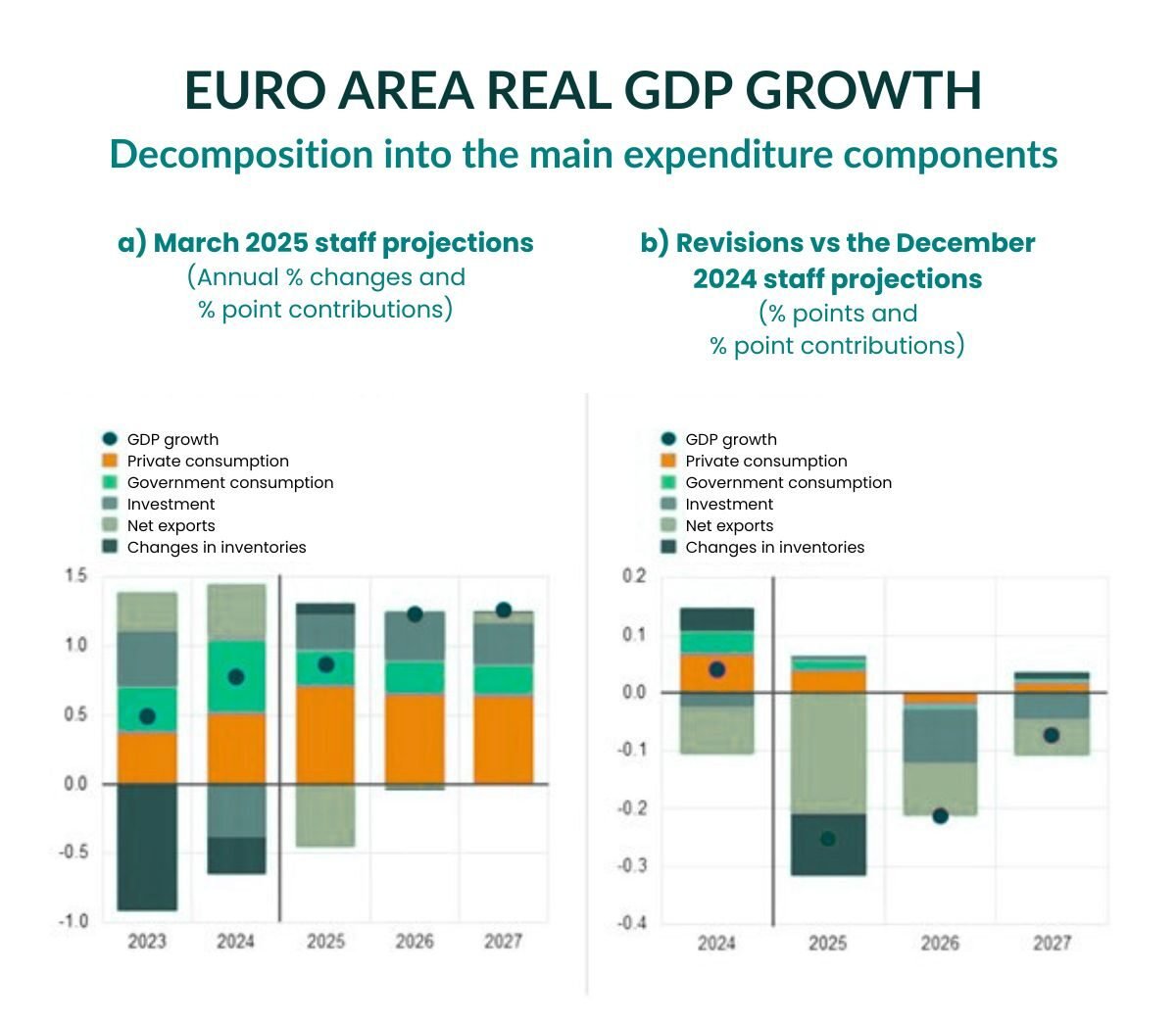
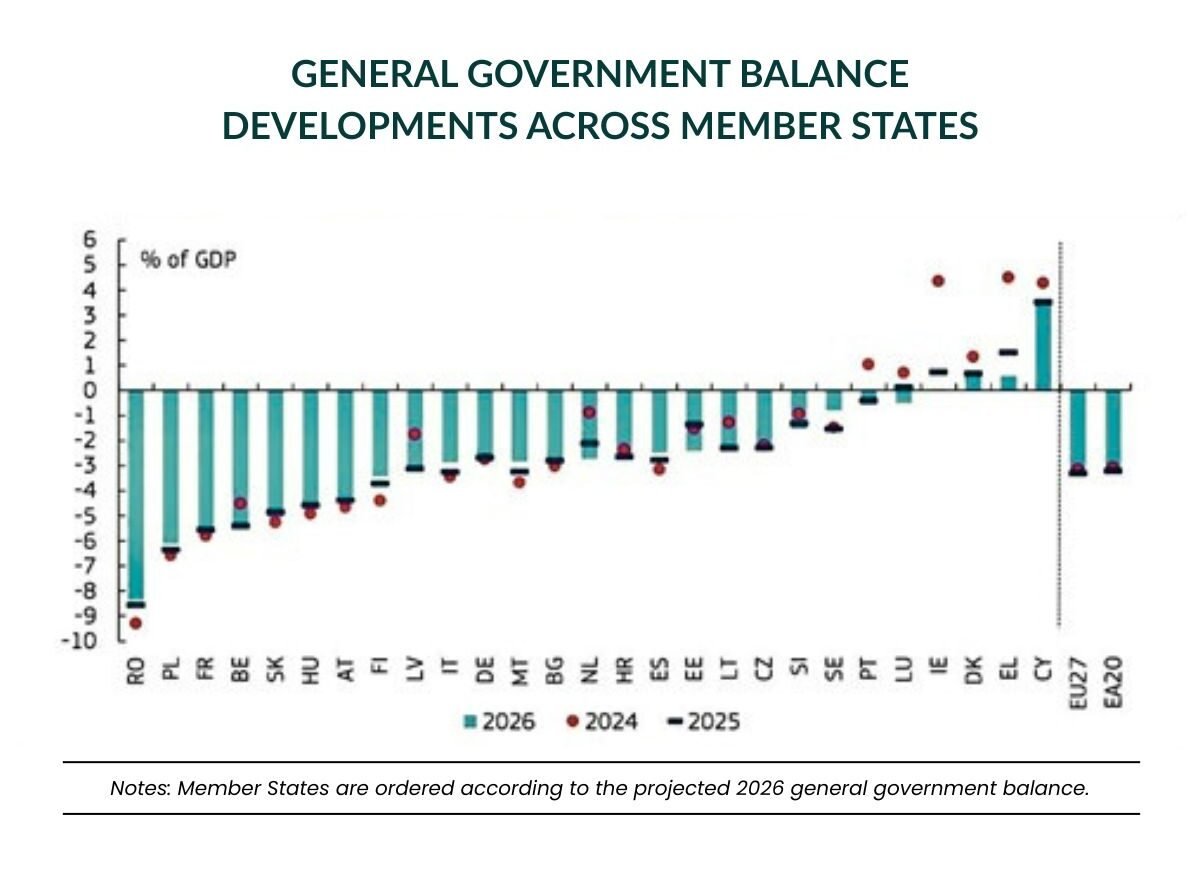
    • Momentum for growth is increasing: Looser fiscal policy will give the economy a boost. While the overall EU fiscal position is projected to remain broadly neutral, with government deficits slightly increasing from 3.2% of GDP in 2024 to around 3.4% in 2026, targeted public investment is set to provide a moderate stimulus. 
    • The age of austerity is gone: Reformed EU fiscal rules prioritize strategic investment over strict deficit caps, allowing for targeted investment in green transition, digitalization, and defense.
    • ESG integration fuels sustainability: Stimulus packages in Europe integrate environmental and social protections, establishing a values- based growth model that is distinct from more risky models elsewhere.

    Europe’s economic scene in 2025 depicts a continent that is struggling with modest growth, lingering  inflation pressures, and the urgent need for structural transformation. With headline inflation expected to decline from 2.4% in 2024 to 2.1% in 2025, and growth patterns varying dramatically, the question isn’t whether Europe needs stimulus, but how to deploy it strategically (European Commission Spring 2025 Economic Forecast).

    The End of Austerity: A Strategic Pivot

    Europe has fundamentally shifted from crisis-driven austerity to strategic investment. The suspended fiscal rules during COVID-19 revealed the power of coordinated spending, with the Recovery and Resilience Facility channeling over €600 billion into green and digital priorities. Germany’s fiscal expansion is expected to have a meaningful positive impact on the broader euro area economy, demonstrating how coordinated investment can generate significant spillover effects across the region. 

    Germany’s constitutional reform, breaking with its traditional “debt brake,” signals a broader European commitment to investment-led growth. The £500 billion infrastructure fund targeting energy transition, digitalization, and defense represents more than fiscal policy; it’s a blueprint for structural transformation (European Commission; Potential Economic Impact of Germany’s Fiscal Reform). 

    Source: European Economic Forecast,Spring 2025
    • Energy Security and Transition: Rising energy costs continue weighing on industrial competitiveness despite easing from wartime peaks. Investments in renewables, grid modernization, and clean technologies will simultaneously address cost pressures and accelerate decarbonization. Early evidence from Germany’s growing electric vehicle industry demonstrates how targeted spending creates competitive advantages ( Clean Energy Wire;Germany’s EV Market Growth and Policy Support,2025 ).
    • Digital Infrastructure and AI: Enhanced connectivity and AI adoption represent productivity multipliers across the economy. France’s digital infrastructure investments and growing corporate commitments to technologies like climate-neutral data centers by 2030 show how public investment catalyzes private sector transformation (EY Europe Economic Outlook 2025).
    • Defense and Resilience: Increasing defence spending from around 2% to 3.5% of GDP could boost economic output, with estimates ranging from a modest 0.3% to a more optimistic 1.5% annual GDP uplift depending on spending efficiency and financing. Beyond economic benefits, higher defense investment strengthens Europe’s geopolitical stability and resilience (European Commission Spring 2025 Economic Forecast; Bruegel Policy Brief 2025; ILzetzki 2025).
    • Single Market Integration: Deepening integration reduces internal barriers and scales innovation. This remains Europe’s most underutilized competitive advantage, requiring sustained investment in regulatory harmonization and cross-border infrastructure (BCG Report: Future of International Cooperation in a fragmented World,2025).


    Financing the Future: A Blended Model

    Europe’s stimulus financing reflects sophisticated institutional coordination. The European Central Bank maintains an accommodative mobility policy with key interest rates recently lowered to around 2% near the top of its estimated neutral range. The Recovery and Resilience Facility has disbursed €306 billion in grants and loans supporting green and digital priorities. Meanwhile, The European Investment Bank leverages private capital through public-private partnerships,blending fiscal expansion with market discipline.

    The EU’s annual budget could increase from 1% of GDP in 2021-2027 to around 1.7% in 2028-2034, marking a substantial increase in coordinated investment capacity (Eurofi Economic Growth Challenges and Responses, June 2025).

    The ESG Advantage: Values-Driven Growth

    Europe’s integration of Environmental, Social, and Governance criteria into stimulus spending creates a sustainable competitive advantage. Green bonds and sustainability-linked funds are rising sharply, driven by EU regulations mandating climate alignment. This approach contrasts with more volatile policy environments elsewhere, offering predictability that attracts long-term investment.

    Corporate commitments reinforce this trajectory. Climate-neutral data centers, sustainable supply chains, and net-zero emissions targets align private sector transformation with public investment priorities, creating reinforcing cycles of growth and sustainability (European Commission Green Deal Industrial plan,2025).

    Managing the Risks

    Political and economic challenges remain. High-debt countries must balance stimulus with sustainability under reformed fiscal rules, while populist opposition could constrain spending scope. Countries like Italy and France raising spending more slowly would limit the overall effort given their big share in the European economy, highlighting coordination challenges.

    Investor sentiment, while generally positive toward Europe’s strategic approach, requires vigilance on inflation and debt risks. The key lies in demonstrating that stimulus generates productivity gains rather than merely boosting demands (European Central Bank Monetary Policy Reports,2025).

    Geopolitical Shocks and Urgency of Strategic Sovereignty 

    The conflict in Ukraine shifted Europe’s perspective on economic sovereignty and foreign policy. Rising energy prices, supply chain disruptions and a renewed emphasis on defence readiness compelled EU members to realign finances toward resilience and autonomy. These shocks exposed essential dependencies on Russian energy, American technology and Chinese manufacturing, ushering in an era of self-reliance. The strategic reaction has been fiscal; increasing public investment to protect key interests. Defense, energy change and digital infrastructure are no longer policy options, they are necessary. As geopolitical instability lingers, Europe’s economic recovery is increasingly being viewed through the prism of national security, competitive survival and strategic independence (BCG Report on International corporation,2025).

    Europe’s Global Leadership Moment

    Strategic public spending positions Europe as a pioneer of values-driven economic expansion. By integrating climate action, innovation, and social inclusion, Europe can demonstrate that sustainable growth models outperform short-term approaches. This leadership extends beyond economics; it shapes global standards for responsible capitalism.

    Failure to invest risks stagnation, increased external dependency, and erosion of global influence. Success creates a replicable model where climate action, technological leadership, and social cohesion reinforce economic competitiveness.

    Source: European Central Bank

    The Path Forward

    Europe’s 2025 fiscal experiment represents more than economic policy; it’s a test of whether democratic societies can pursue long-term transformation while maintaining popular support. The integration of green transition, digital innovation, and defense capabilities through coordinated public investment offers a roadmap for sustainable prosperity.

    The question isn’t whether Europe can afford to spend, but whether it can afford not to. In an era of global fragmentation and technological disruption, strategic public investment isn’t just good economics, it’s essential statecraft. Europe’s success in 2025 will determine whether it leads the next phase of global economic development or becomes dependent on others’ innovations and standards.

    The stakes couldn’t be higher, and the opportunity couldn’t be clearer.

    Sources

    • European Economic Forecast, Spring 2025
    • European Central Bank, Macroeconomic Projections 
    • BCG Report on International Cooperation,2025
    • European Central Bank, Monetary Policy Report 
    • Eurofi Economic Growth Responses and Challenges,2025
    • Clean Energy Wire;Germany’s EV Market Growth and Policy Support
    • EY Europe Economic Outlook 2025
    • European Commission Green Deal Industrial plan
    • Bruegel Policy Brief 2025; ILzetzki 2025
    Authors
  • Can the world afford $5-7 trillion a year for green goals in 2025?

    Key takeaways
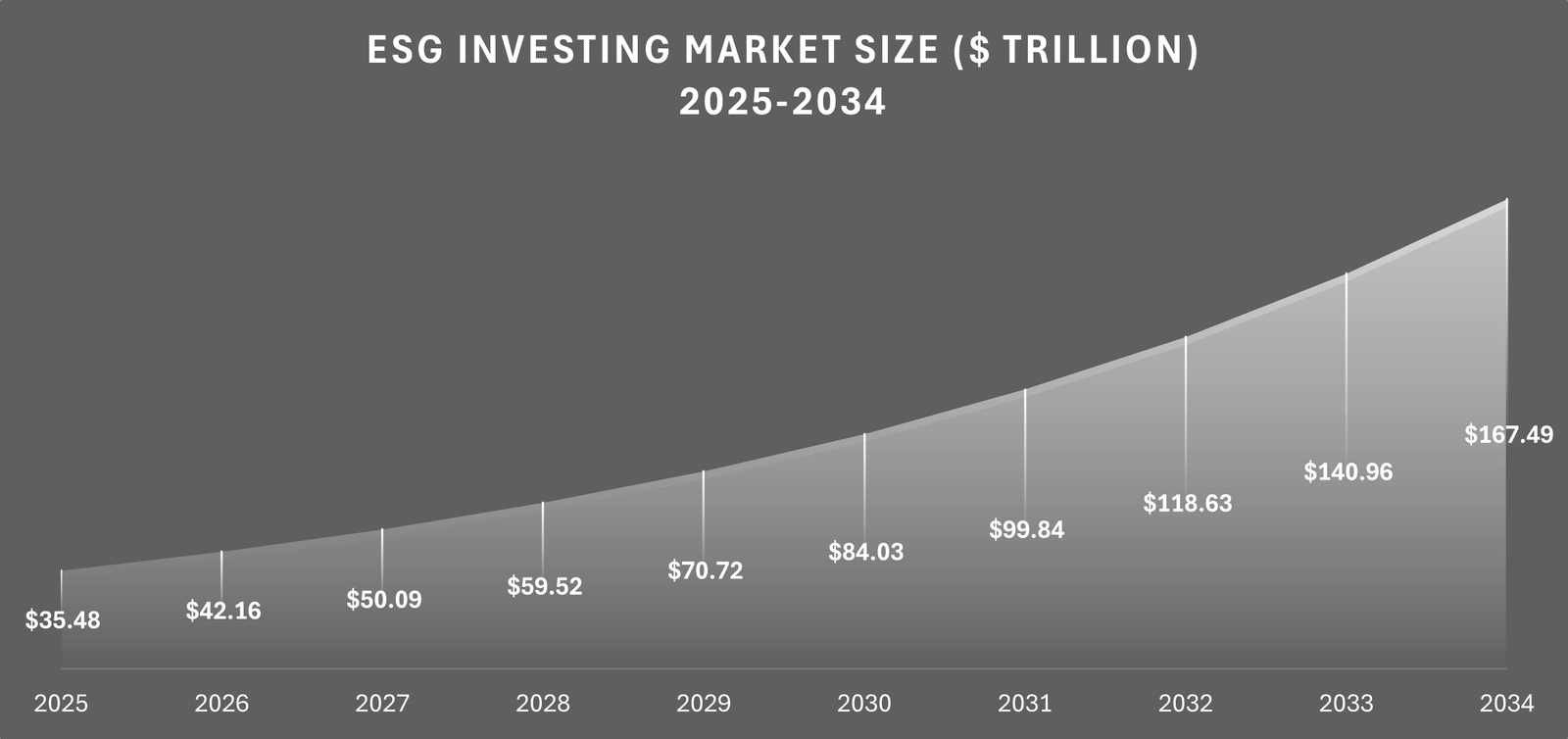
    • ESG frameworks have become essential for managing systemic risks, with the global ESG finance market reaching $6.3 trillion in 2024 and ESG investing market projected to grow to $167 trillion by 2034 (precedence research)
    • Trump’s 2025 regulatory rollbacks have created policy fragmentation, yet Europe’s leadership demonstrates that ambitious ESG frameworks drive both compliance and competitive advantage.
    • The $5-7 trillion annual investment required for green goals is not just affordable but economically imperative, climate inaction costs far more than sustainable transformation.


    Climate disasters already cost the global economy $300 billion annually, a figure projected to double  by 2030 without decisive intervention ( UNDRR )Meanwhile ,the global ESG finance market has reached $6.3 trillion in 2024 (Business Research Company), the broader ESG investing market ,which includes assets with ESG criteria, was valued at nearly $30 trillion in 2024 and is projected to surpass $167 trillion by 2034 (Precedence Research).These numbers tell a story: Environmental, Social and Governance frameworks are no longer peripheral considerations but central to economic stability.

    Figure: Projected Global ESG Investing Market Size (Source: Precedence Research )

    With the Trump administration’s aggressive rollback of climate policies and ongoing debates over financing green transitions, a critical question emerges: Can the world afford to invest $5-7 trillion annually in sustainable goals, or can it afford or not to?

    The power of ESG integration

    ESG frameworks deliver tangible benefits across business performance and risk management. Companies adopting comprehensive ESG practices report upto 20% reduction in energy costs, improved access to capital through sustainability, linked loans and enhanced resilience against regulatory risks. Around 90% of S&P 500 companies now publish ESG reports, reflecting widespread recognition of these frameworks’ strategic value (Key ESG)

    The ESG reporting software market exemplifies this momentum, growing from $1.16 billion in 2024 to a projected $1.39 billion in 2025, a 19.6% increase driven by regulatory requirements and investor demand (Business Research Company). This growth reflects genuine value creation through improved decision making and risk management.

    The pre-Trump ESG foundation

    Before current policy reversals, the United States had begun aligning federal initiatives with global climate commitments. The Paris Agreement provided coordination frameworks, while federal clean energy incentives catalyzed private investment in renewable technologies. Green bond issuance  grew consistently, channeling billions into renewable energy and sustainable infrastructure projects.

    This era demonstrated ESG’s role as both ethical imperative and market opportunity, proving that government leadership could accelerate market-driven sustainability transitions (Financier Worldwide,2025, Columbia Law Climate Blog,2025).

    Europe’s ESG leadership: Setting global standards

    Europe exemplifies how ambitious regulatory frameworks drive both compliance and competitive advantage. The Corporate Sustainability Reporting Directive (CSDR) mandates ESG disclosures for over 50,000 companies, creating unprecedented transparency. This regulatory clarity has catalyzed remarkable investment: European low carbon energy investments reached around $2 trillion in 2024, an 11% year on year increase (European Commission,2025).

    European banks integrate climate risks assessments into lending practices, charging higher interest rates to carbon intensive firms while offering preferential terms for sustainable projects. Green bond issuance has reached record levels, supporting the infrastructure projects that enhance both environmental performance and economic competitiveness.

    The European approach demonstrates that regulatory rigor and economic growth are complementary rather than competitive objectives (Climate Bonds Initiative,2025, European Banking Authority,2025).

    Trump’s 2025 Agenda: Fragmentation and uncertainty

    The current administration has implemented sweeping ESG policy reversals, creating significant regulatory fragmentation. Key actions include withdrawing from the Paris Agreement, rolling back federal clean energy incentives, and weakening SEC climate risk disclosure rules.

    These shifts generated immediate market impacts, with ESG funds experiencing approximately $8.6 billion in outflows during early 2025 (Edie Net).

    Figure: ESG-Mandated Assets as Share of Total U.S. Managed Assets (2012-2025) (Source: US SIF Foundation and Deloitte Financial Services,2025 / Via Deloitte Insights )

    However, this federal retreat hasn’t eliminated ESG momentum entirely. States like California and New York continue to enforce stringent climate regulations, including emissions caps and mandatory sustainability disclosures, resulting in a complex patchwork of requirements that companies must navigate. This patchwork of rules makes it more expensive and complicated for companies to follow regulations, but it also shows that ESG ideas remain strong and important at the state and market levels (Financier Worldwide,2025).

    Navigating the fragmented landscape

    Current regulatory fragmentation presents both challenges and opportunities. Multinational corporations face increased compliance costs across differing jurisdictions, yet this rewards companies adopting comprehensive ESG frameworks capable of meeting the highest standards.

    Private capital continues flowing toward sustainable investments despite federal uncertainty with institutional investors significantly increasing their allocations to renewable energy, reflecting strong momentum in 2025. Recent reports indicate that many investors plan to boost their renewable energy investments by 10% to 20% in the coming years, driven by growing demand for clean energy and supportive policies, demonstrating market fundamentals drive decisions more than political rhetoric (KPMG Energy Transition Outlook 2025).

    The ESG rating services market grew from $11 billion in 2024 to $12 billion in 2025, evidence of sustained demand for sustainability focused transparency (The Business Research Company).

    Financing the green transition

    The question of whether the world can afford to invest $5-7 trillion annually in green goals misses the point. Climate disasters already cause huge economic losses, and these damages are expected to double by 2030 if no action is taken. The real choice is between spending money now to build resilience or paying much more later to manage crisis.

    The green bond market shows that the capital is available for sustainable projects. So far, by the end of 2024, the global cumulative issuance of green bonds reached approximately $3 trillion in 2024 alone, with $670 billion issued in green bonds, underscoring the continued expansion of sustainable finance.

    Table: ESG Investing Market Size (Source: Precedence Research)

    At the same time, private companies are innovating to lower the costs of clean technologies while making them more effective, making green investments increasingly attractive financial decisions (Climate Bonds Initiative,2025, International Energy Agency,2025).

    An investment in resilience

    The substantial annual investment requirement represents not a cost but an opportunity to create stronger and more resilient economies. The ESG investing market is expected to reach $131 trillion by 2032, increasing at nearly 17% CAGR from 2024 to 20232.This shows that investors have strong and lasting confidence in sustainable business practices (Globe Newswire).

    At Axial Consulting, we recognize this transformation is both inevitable and essential. Our climate cannot afford continued degradation, our economies cannot sustain mounting disaster costs, and our societies cannot ignore growing governance failures. ESG frameworks provide practical tools for addressing these interconnected challenges while creating stakeholder value. The world can afford this investment because it cannot afford the alternative. Climate disasters, resource scarcity, and social instability impose far greater costs than proactive sustainability measures. Europe’s leadership demonstrates that ambitious ESG frameworks drive innovation and competitiveness.

    Even amid U.S. federal policy reversals, state governments, private investors and corporations continue advancing sustainable practices because they recognize the fundamental economic logic underlying ESG integration.

    The question is whether we can afford to delay this essential investment any longer. The time for half measures has passed. The future demands bold action, guided by the comprehensive frameworks that ESG principles provide.

    Sources 
    • Precedence Research.
    • Business Research Company. ESG Finance and Reporting Software Market Outlook 2024-2025.
    • UNDRR( United Nations Office For  Disaster Risk Reduction). Global Climate Risk Report.
    • Key ESG. S&P 500 reporting trends. 
    • Financier Worldwide. ESG Policy Rollbacks and Market Impacts 
    • Columbia Law School Climate Law Blog. ESG Policy and Regulatory Frameworks(2025).
    • European Commission
    • Climate Bonds Initiative 
    • KPMG. Energy Transitions Outlook 2025.
    • The Business Research Company. ESG Rating and Services Market Growth 
    • International Energy Agency. Clean Energy Investments Trends.
    • Globe Newswire. Global Energy Market Forecasts to 2032.

    Authors

  • Pakistan’s Fitch Upgrade Progress Amid Persistent Challenges

    Pakistan has secured its first sovereign rating upgrade in six years, a symbolic return from the brink of default. Yet market experts warn the country’s economic recovery remains fragile and deeply reliant on external support.

    Fitch Ratings upgraded Pakistan’s long-term foreign currency rating from ‘CCC+’ to ‘B-’ with a stable outlook in April, acknowledging fiscal progress under the country’s latest IMF program. The upgrade reflects renewed investor confidence in Pakistan’s macroeconomic management following a near default crisis in 2023 that sent borrowing costs soaring and pushed the country to the brink of financial collapse.

    According to the Fitch report, the upgrade reflects “increased confidence that Pakistan will sustain its recent progress on narrowing budget deficits and implementing structural reforms.’’

    However, Fitch also cautioned that “implementation risks remain, and financing needs are still large,’’ pointing to the ongoing challenges Pakistan must navigate.

    This mixed outlook suggests that while international confidence is returning, sustained reforms and careful fiscal management will be critical to maintaining momentum and avoiding setbacks.

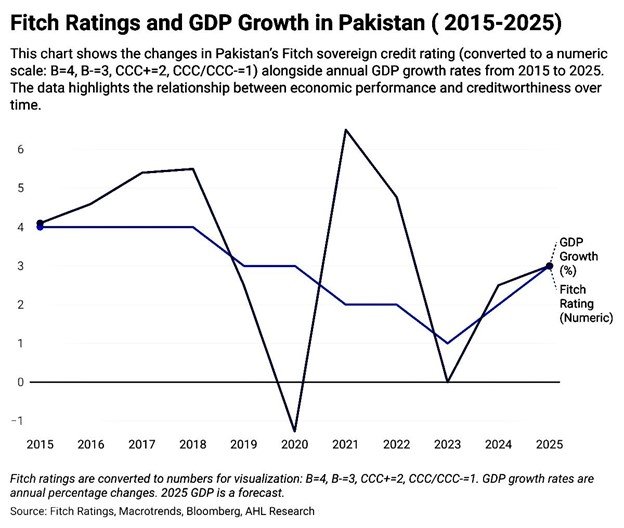
    Dual-line chart comparing Pakistan’s Fitch credit rating and GDP growth rate from 2015 to 2025. The chart illustrates a decline in credit rating between 2018 and 2023, with the lowest point in 2022, and a gradual improvement forecasted till 2025. GDP growth fluctuates sharply, dipping below zero in 2020 and peaking in 2021.

    Market Response Shows Cautious Optimism

    The rating upgrade triggered an immediate but measured market response. The KSE-100 index gained 385 points (0.33%) on April 15, closing at 116,775.50 as domestic investors responded to the positive signal.

    However, Pakistan’s borrowing costs remain significantly elevated compared to regional peers, with Moody’s projecting that interest payments will consume nearly 40% of the country’s 2025 budget, according to an April 18 report from Business Recorder. This debt burden represents a stark contrast to the 13% median for ‘B-’ rated peers, highlighting the substantial fiscal constraints Pakistan continues to face despite its improved rating, as detailed in Pakistan’s Debt Sustainability Report FY2025-FY2027.

    IMF Program Delivers, But Implementation Risks Loom

    The upgrade primarily stems from Pakistan’s adherence to recent IMF benchmarks and several measurable improvements:

    • Fiscal deficit projected to narrow to 6% of GDP in FY25(from nearly 7% in FY24)
    • Primary surplus expected to more than double to over 2% of GDP
    • Foreign exchange reserves rebounded to nearly $18 billion in March 2025, up from less than $8 billion in early 2023
    • Current account posted a $700 million surplus in the first eight months of FY25

    The March 2025 staff-level agreement with the IMF on a $7 billion Extended Funded Facility and a new  $1.3 billion Resilience and Sustainability Facility has reinforced confidence in the country’s economic reforms and policy direction according to the IMF. The recent IMF review has acknowledged Pakistan’s progress in implementing structural reforms and meeting fiscal targets. Despite this progress, the review pointed out persistent economic risks, including elevated public debt levels, limited fiscal space, and structural challenges that could impede sustainable growth. While the fiscal support signals confidence in Pakistan’s reform agenda, the IMF stressed the need for continued reform efforts to secure enduring economic stability and growth.

    Pakistan vs Peers: Still Lagging Despite Progress

    Despite the upgrade, Pakistan remains well below investment grade across all major rating agencies, with Moody’s and S&P yet to follow Fitch’s move.

    The country faces substantial external debt repayments of $8 billion in FY25 and $9 billion in FY26, necessitating continued reliance on multilateral and bilateral financing sources.

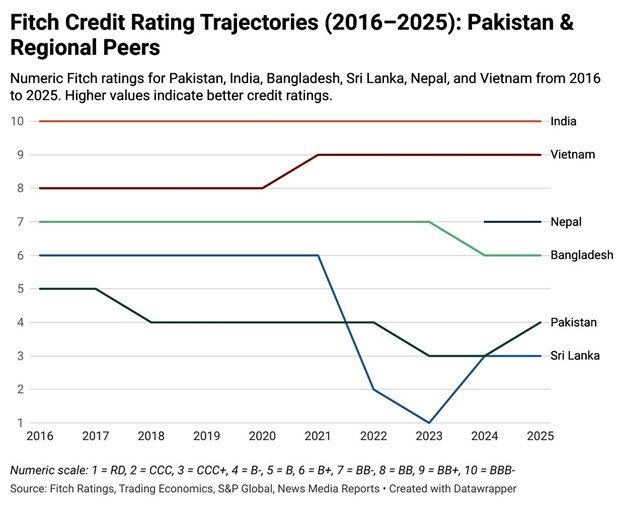
    As shown in the chart below, Pakistan’s credit rating has fluctuated significantly over the past decade, with a notable downgrade to ‘CCC-’ in 2023 and now a recent upgrade, while most regional peers have maintained higher and more stable ratings.

    Line chart showing Fitch credit rating trends from 2016 to 2025 for Pakistan, India, Bangladesh, Sri Lanka, Nepal, and Vietnam. India and Vietnam maintain high ratings, while Pakistan and Sri Lanka show steep declines around 2022 followed by partial recovery. Ratings are based on a numeric scale where higher values indicate better creditworthiness.

    Pakistan’s continued reliance on external financing highlights a key vulnerability, especially as financial reserves across South Asia remain limited after years of repeated shocks. While countries like Bangladesh and Vietnam have benefitted from stronger export performance and investment flows, Pakistan faces ongoing challenges in strengthening its fiscal position and mobilizing domestic revenues, according to the World Bank’s April 2025 South Asia Development Update.

    Rating Agencies: Lagging Indicators or Valuable Signals?

    Financial analysts often note that rating agencies tend to reflect past economic developments rather than predict future trends. Zafar Masud, former advisor to Pakistan’s Ministry of Finance, has argued in Dawn that the real challenge for Pakistan is to sustain fiscal discipline beyond short-term political cycles, a point that remains central as the country navigates recent upgrades and ongoing reforms.

    Four Key Risks to Pakistan’s Economic Recovery

    Despite recent progress, significant challenges threaten to derail Pakistan’s economic recovery:

    1. Implementation Risks

    Pakistan’s history with IMF programs shows reforms frequently stalling during political transitions. Fitch specifically notes in its April 15 press release that “ the  current consensus on reforms could weaken as elections draw nearer   and political volatility increases.”

    2. External Financing Dependency

    With limited capital market access. Pakistan remains heavily reliant on bilateral and multilateral financing to meet substantial debt obligations in FY 25-26.

    3. Fiscal Fragility

    The interest payment-to-revenue ratio is projected to reach 59% in FY25, severely limiting capacity for development expenditures or ability to absorb economic shocks. The latest IMF warns that without further reforms to broaden the tax base and reduce expenditure rigidities; fiscal sustainability remains at high risk despite current progress. The IMF acknowledges progress, including a 2.0% GDP primary surplus in H1 FY25 but emphasizes that sustained reforms are critical to address Pakistan’s narrow revenue base and high debt-servicing burden.

    4. External Vulnerabilities

    Ongoing global trade tensions and security concerns in regions bordering Afghanistan and in Balochistan continue to pose risks to export performance and investor confidence.

    What’s Lies Ahead for Pakistan?

    While Pakistan’s recent credit rating upgrade is a positive development,significant challenges remain before sustainable economic growth can be realized.Managing over $8 billion in external debt repayments due in FY 2025-26 will test the country’s fiscal resilience. Expanding the tax base and reducing dependence on external borrowing are essential steps to stabilize the economy and break the recurring cycle of financial instability.

    Projected GDP growth of around 3% in 2025, according to the IMF,falls short of the 5-6% needed to meet the demands of Pakistan’s expanding labor force,as noted by the State Bank of Pakistan.

    The upgrade should be viewed as a milestone rather than an endpoint. While the recent IMF review and credit rating upgrade represent important votes of confidence, they do not guarantee smooth sailing ahead. The IMF has specifically cautioned that  Pakistan’s debt sustainability remains precarious, and further structural reforms are essential. Long-term progress hinges on consistent policy implementation, fiscal discipline and creating an investment friendly environment that can attract both domestic and foreign capital. Pakistan’s economic future depends not on temporary relief through external financing but on addressing fundamental structural weaknesses that have led to recurring cycles of crisis.

    Sources

    • Fitch Ratings, Pakistan Sovereign Credit Rating Upgrade Press Release, April 15, 2025
    • Bloomberg, Pakistan Gains Credit Upgrade from Fitch, April 16, 2025
    • Ministry of Finance, Pakistan Debt Sustainability Report FY2025-FY2027
    • International Monetary Fund (IMF), World Economic Outlook, April 2025
    • State Bank of Pakistan, Monetary Policy Statement, April 2025

    Authors

  • How to do a feasibility study for a business?

    Conducting a feasibility study is a critical first step when starting a new business or expanding an existing one. The reason is that a feasibility study helps assess the viability of a business idea. Without one, professionals cannot make informed decisions regarding a new project or venture.

    To implement a successful feasibility study for a business, it is necessary to understand its various components and how to prepare them. In this guide, we’ll provide a detailed layout of how to do a feasibility study for a business, examining key constituents and the process involved.

    What is a Feasibility Study?

    A feasibility study is an assessment of a proposed business idea or project. It systematically evaluates business components based on practicality, sustainability, and profitability. The goal is to determine whether the project or idea is technically, financially, and organizationally feasible. In other words, a feasibility study asks: “Is this project viable, and is it worth pursuing?”

    A well-executed feasibility study reduces the risk of failure by identifying potential obstacles before committing significant resources. This allows a company to develop solutions to these challenges and plan an appropriate strategy. By providing a comprehensive analysis of the project’s potential outcomes, a feasibility study for a business guides professionals towards better decision-making.

    Types of a Feasibility Study for a Business

    Generally speaking, there are five main types of a feasibility study. They are:

    1. Market Feasibility
    2. Technical Feasibility
    3. Financial Feasibility
    4. Legal Feasibility
    5. Organizational Feasibility
    1. Market Feasibility

    As the name suggests, a market feasibility study determines whether a project will gain market success. It assesses the demand for a product or service, the target audience, potential competition, and market trends. A thorough market analysis will help a business determine whether its idea is needed and how to position itself in the market.

    1. Technical Feasibility

    Technical feasibility determines whether a project is technically achievable; does the company possess the resources and expertise for the project’s requirements? This includes production capacity, raw materials, supply chains, etc. A comprehensive technical feasibility study will also include requirements for regulatory compliance.

    1. Financial Feasibility

    Financial feasibility evaluates the financial aspects of a business project, including the cost of starting and running the business, potential revenue, profitability, and the project’s break-even point. A financial feasibility study for a business helps determine whether it will generate enough income to cover its expenses and provide a satisfactory return on investment (ROI).

    1. Legal Feasibility

    A legal feasibility study ensures a business complies with all relevant laws and regulations. It involves analyzing the legal requirements for all activities and deliverables that fall under the project’s scope. Moreover, a legal feasibility study helps a business select an appropriate legal structure. Every legal structure has its benefits and disadvantages such as limited liability corporations (LLCs), which reduce liability for business partners.

    1. Organizational Feasibility

    An organisational feasibility study assesses the capability of a business to manage a project. It focuses on the internal structure, management, and personnel needed to execute a business plan. An organisational feasibility study may also include insights into the ethics of the business, demonstrating to stakeholders the business’s trustworthiness and level of responsibility.

    Steps to Conduct a Feasibility Study for a Business

    The steps on how to do a feasibility study for a business can be broken down into 7.

    Step 1: Conduct Preliminary Research

    A feasibility study begins by gathering information about the market, competition, and industry trends. This helps identify potential opportunities and challenges. Preliminary research aims to screen project ideas before excessive time and resources have been spent on them.

    Step 2: Establish a Project Income Statement

    A project income statement determines the revenue necessary to cover direct and indirect costs, accounting for expected income growth. Once an amount has been calculated, sources for funding can be established.

    Step 3: Analyze the Market

    A feasibility study for a business must assess the demand for the new product or service. This assessment is based on market trends, customer preferences, and competitor performance. Surveys, interviews, and focus groups are all used to gather insights into the targeted customer base, and subsequently determine opportunities for market expansion.

    Step 4: Prepare Organisation and Operations

    Once a foundation has been built for the project, work must begin organising operations and costs. This includes a thorough breakdown of start-up costs, investments, and operational expenses. Everything from equipment to overhead costs must be accounted for.

    Step 5: Produce an Opening Day Balance Sheet

    An opening day balance sheet estimates the project’s assets and liabilities. Begin by preparing a list of all necessary assets. Assets may range from working capital to land and buildings. Similarly, liabilities like leasing or purchasing land, buildings, equipment, and financing accounts receivable must be considered. Though a list may seem straightforward, compiling it can be detailed, requiring careful consideration of all financial aspects.

    Step 6: Review Data              

    Reviewing data is essential. Re-examine the projected income statement and see whether it reflects realistic expectations, considering all expenses and revenue heads. Identify risks and consider contingencies, anticipating potential market changes that could impact projections. A final review is crucial for confirming that everything aligns and whether adjustments must be made.

    Step 7: Make a Final Decision

    After a feasibility study for a business has been completed, all findings must be reviewed and a final decision must be made.  The project may be put on hold if significant risks or challenges exist. In that case, alternative solutions or revisions can be considered. If the final review reveals that the project fails to meet long-term goals, the project may be abandoned completely. However, if the project meets all requirements, the project can be put into production.

    Learning how to do a feasibility study for a business is an essential tool for assessing viability and potential success. At Axial Consulting, our team supports clients in conducting comprehensive feasibility studies. From assessing market dynamics to evaluating financial and operational viability, we offer expert guidance at every stage. Get in touch today to learn how we can help you turn your vision into a sustainable success.